
Introduction
If you are involved in manufacturing, importing, or selling products in India, you must have heard about BIS certification. Many people search online to understand the BIS full form and what is BIS. BIS plays a vital role in ensuring product quality, safety, and standardization across India.
In this blog, we will explain the BIS full form, meaning of BIS, its functions, objectives, certification schemes, and why it is important for businesses and consumers.
BIS Full Form
The BIS full form is Bureau of Indian Standards. BIS is the national standards body of India, working under the Ministry of Consumer Affairs, Food & Public Distribution, Government of India.
What is BIS?
BIS (Bureau of Indian Standards) is an organization responsible for developing and maintaining standards for products, services, and systems in India. It ensures that products sold in the Indian market meet defined quality, safety, and performance standards.
BIS certification helps protect consumers from unsafe or substandard products and supports fair trade practices.
History of BIS
The Bureau of Indian Standards was established in 1986, replacing the earlier Indian Standards Institution (ISI). Since then, BIS has expanded its role to include product certification, hallmarking of precious metals, laboratory testing, training, and international cooperation.
Objectives of BIS
The main objectives of BIS are:
-
To ensure quality and safety of products
-
To promote standardization and quality consciousness
-
To protect consumer interests
-
To support industrial growth and exports
-
To reduce health and safety risks
-
To align Indian standards with international standards
Functions of BIS
BIS performs several important functions in India:
1. Standards Formulation
BIS develops Indian Standards (IS) for products, materials, processes, and systems.
2. Product Certification
BIS grants licenses to manufacturers whose products comply with Indian Standards.
3. Hallmarking
BIS operates hallmarking schemes for gold, silver, and other precious metals.
4. Laboratory Services
BIS has testing laboratories to verify product compliance.
5. Training & Awareness
BIS conducts training programs to promote quality awareness.
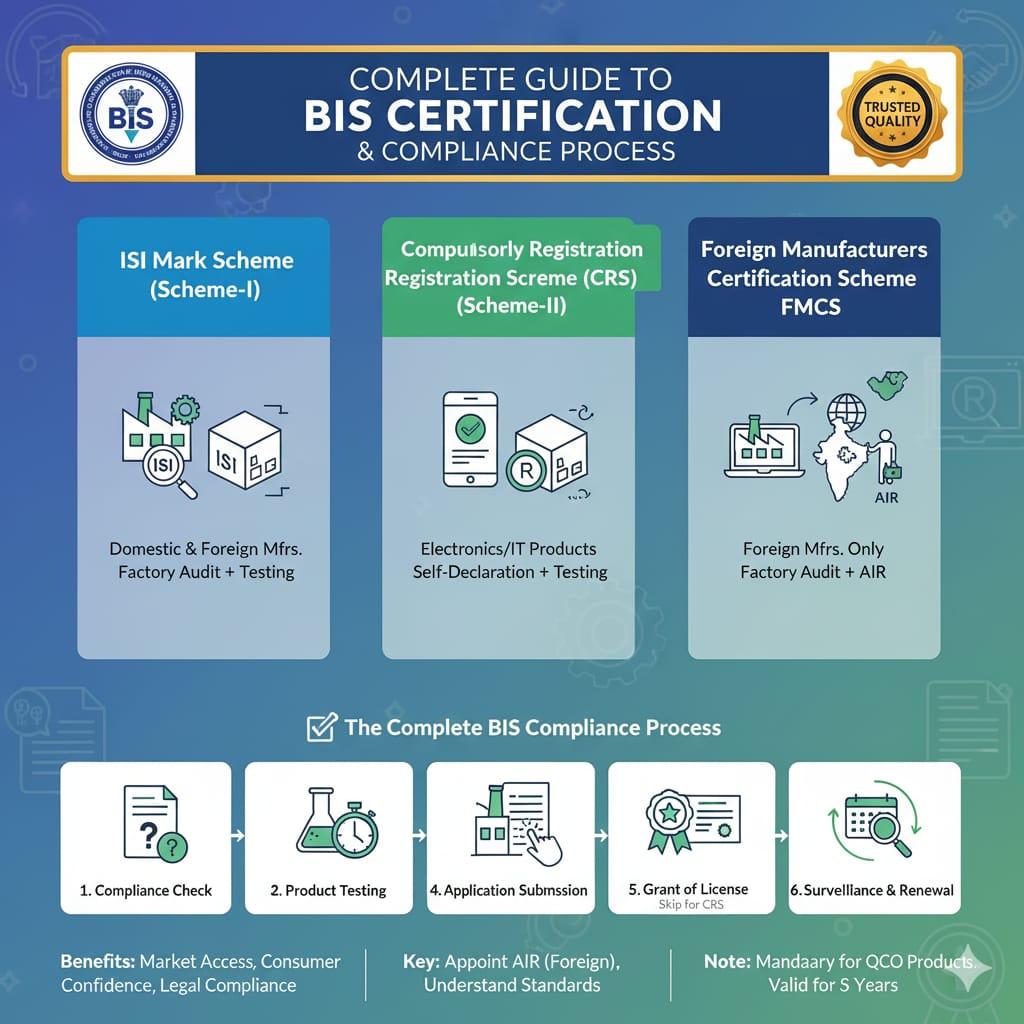
Types of BIS Certification Schemes
BIS operates different certification schemes depending on the product and applicant type:
1. ISI Mark Scheme
Applicable for domestic manufacturers producing goods such as cement, electrical appliances, steel products, etc.
2. CRS (Compulsory Registration Scheme)
Mandatory for electronics and IT products like mobile phones, laptops, power adapters, LED lights, etc.
3. FMCS (Foreign Manufacturers Certification Scheme)
Designed for foreign manufacturers exporting regulated products to India.
4. Hallmarking Scheme
Applicable to gold and silver jewelry and artifacts.
Why is BIS Certification Important?
Understanding what is BIS also means understanding why it matters.
For Consumers
-
Ensures product safety
-
Guarantees quality and reliability
-
Protects from counterfeit and unsafe products
For Manufacturers
-
Legal compliance with Indian regulations
-
Increased brand trust and market acceptance
-
Easier access to Indian markets
-
Reduced risk of penalties and product rejection
Products Covered Under BIS Certification
Some commonly regulated products include:
-
Electrical appliances
-
Electronics and IT products
-
Steel and cement
-
Chemicals and fertilizers
-
Medical equipment
-
Toys and baby products
-
Household items
Many products cannot be sold in India without BIS certification.
BIS Certification Process (Overview)
Although the exact process varies by scheme, the general steps include:
-
Product testing in a BIS-recognized laboratory
-
Submission of application with documents
-
Factory inspection (if applicable)
-
Evaluation by BIS authorities
-
Grant of BIS license or registration
Difference Between BIS and ISI
-
BIS is the organization (Bureau of Indian Standards)
-
ISI is the certification mark issued by BIS
So, ISI mark products are certified by BIS.
Challenges Without BIS Certification
Selling regulated products without BIS approval may lead to:
-
Heavy penalties
-
Product seizure
-
Import rejection
-
Legal action
-
Loss of consumer trust
Conclusion
To summarize, the sunconsultants.co.in. , and BIS is India’s national authority for quality and safety standards. BIS certification is essential for ensuring that products meet Indian quality benchmarks and comply with legal requirements. Whether you are a manufacturer, importer, or consumer, understanding what BIS is and why it matters can help you make informed decisions and avoid compliance risks.

 English
 Arabic
 French
 Spanish
 Portuguese
 Deutsch
 Turkish
 Dutch
Dutch
 Italiano
 Russian
 Romaian
 Portuguese (Brazil)
 Greek
Greek