
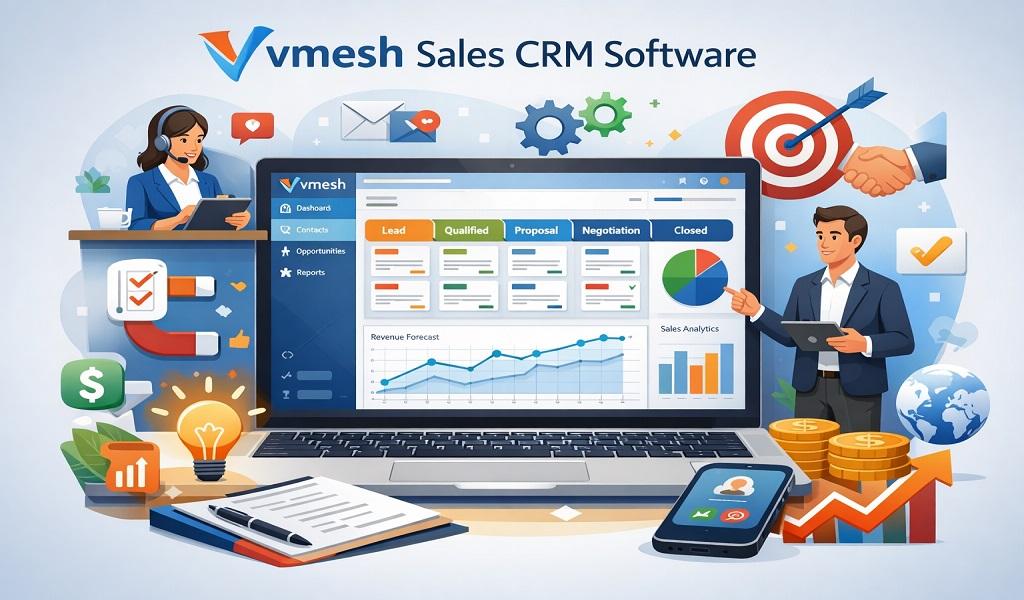
Choosing the right Sales CRM (Customer Relationship Management) system is one of the most important decisions a business can make for its sales success. A Sales CRM is not just a tool for storing customer information; it is the backbone of your sales operations. It influences how your team manages leads, communicates with prospects, tracks performance, and builds long-term customer relationships. With so many options available in the market, selecting the right CRM can feel overwhelming. This guide will help you understand what to look for and how to choose a Sales CRM that truly fits your business needs.
The first step in choosing the right Sales CRM is to clearly define your business goals. Ask yourself what you want to achieve with a CRM. Are you trying to improve lead management, increase conversion rates, enhance team collaboration, or gain better visibility into your sales pipeline? Different CRMs excel in different areas, so having a clear set of objectives will guide your decision-making. For example, a small startup may prioritize simplicity and affordability, while a large enterprise might focus on advanced analytics, automation, and scalability.
Next, evaluate your current sales process. Understanding how your sales team operates today will help you choose a CRM that supports and improves your workflow rather than disrupting it. Map out your sales stages, from lead generation to deal closure and post-sale follow-ups. Identify bottlenecks, inefficiencies, and areas where automation could save time. The right CRM should align with your process and make it more efficient, not more complicated.
Ease of use is a critical factor when choosing a Sales CRM. Even the most powerful CRM will fail if your team finds it difficult to use. Look for a system with an intuitive interface and simple navigation. Your sales team should be able to adopt the CRM quickly with minimal training. A user-friendly CRM increases adoption rates, ensures accurate data entry, and maximizes the return on your investment.
Customization and flexibility are also essential. Every business is unique, and your CRM should be adaptable to your specific needs. Look for a platform that allows you to customize fields, workflows, pipelines, and dashboards. This ensures that the CRM reflects how your business actually operates. Flexibility is especially important if your business is growing or evolving, as your CRM should be able to adapt to future changes.
Another key consideration is automation. A good Sales CRM should reduce the amount of manual work your team has to do. Features like automated lead assignment, email follow-ups, task reminders, and data updates can significantly boost productivity. Automation helps your sales team focus on what truly matters: building relationships and closing deals. When evaluating CRM options, check how advanced and easy-to-use their automation features are.
Integration capabilities play a major role in selecting the right CRM. Your CRM should work seamlessly with the tools you already use, such as email platforms, marketing automation software, customer support systems, and accounting tools. Integration ensures smooth data flow between departments and creates a unified view of the customer. For example, when marketing passes a qualified lead to sales, the CRM should automatically capture all relevant information without manual input.
Reporting and analytics are vital for making data-driven decisions. The right Sales CRM should provide clear and actionable insights into your sales performance. Look for features such as pipeline tracking, conversion rate analysis, revenue forecasting, and performance dashboards. These tools help sales managers understand what is working, what is not, and where improvements are needed. Strong analytics turn your CRM into a strategic asset rather than just a data storage system.
Scalability is another important factor, especially if you plan to grow your business. A CRM that works well for a small team today should still be effective as your sales operations expand. Check whether the CRM can handle an increasing number of users, contacts, and data without performance issues. Also, consider whether it offers advanced features that you might need in the future, such as AI-driven insights or complex workflow automation.
Security and data protection should never be overlooked. Your CRM will store sensitive customer information, including contact details, communication history, and possibly financial data. Make sure the CRM provider follows strong security standards, such as data encryption, regular backups, and compliance with data protection regulations. A secure CRM not only protects your business but also builds trust with your customers.
Cost is, of course, a major consideration. Sales CRM pricing varies widely, from free basic versions to premium enterprise solutions. When evaluating costs, look beyond the monthly subscription fee. Consider additional expenses such as setup, customization, training, and ongoing support. The cheapest option is not always the best. Instead, focus on value for money and choose a CRM that offers the features you need at a reasonable cost.
Customer support and training resources are often underestimated but are crucial for successful CRM implementation. Even the best CRM can face technical issues or require guidance during setup. Choose a provider that offers reliable customer support, clear documentation, video tutorials, and onboarding assistance. Good support ensures that your team can resolve problems quickly and continue working efficiently.
Another important aspect is mobile accessibility. Sales teams are often on the move, attending meetings, making calls, and visiting clients. A CRM with a strong mobile app allows sales representatives to access and update customer information in real time, no matter where they are. This ensures data accuracy and keeps the entire team aligned.
User feedback and reviews can provide valuable insights into how a CRM performs in real-world situations. Look for reviews from businesses similar to yours in size and industry. Pay attention to comments about usability, reliability, customer support, and overall satisfaction. While no CRM is perfect, consistent feedback can help you identify potential strengths and weaknesses.
Before making a final decision, always take advantage of free trials or demos. Most CRM providers offer trial periods that allow you to test their platform. Use this time to involve your sales team and gather their feedback. Let them explore features, simulate real sales scenarios, and identify any challenges. Their input is essential because they will be the primary users of the system.
Finally, think long-term. Choosing a Sales CRM is not just about solving today’s problems but also about supporting your future growth. The right CRM should evolve with your business, adapt to changing needs, and continuously add value to your sales operations. It should become a central hub that connects your sales strategy, customer relationships, and business goals.
In conclusion, selecting the right Sales CRM requires careful evaluation of your goals, processes, budget, and future plans. By focusing on usability, customization, automation, integration, analytics, scalability, and security, you can find a CRM that truly empowers your sales team. The right CRM will streamline your operations, improve productivity, enhance customer relationships, and drive sustainable revenue growth. With the right choice, your Sales CRM becomes more than a tool—it becomes a strategic partner in your success.

 English
 Magyar
 Arabic
 French
 Spanish
 Portuguese
 Deutsch
 Turkish
 Dutch
Dutch
 Italiano
 Russian
 Romaian
 Greek
Greek