
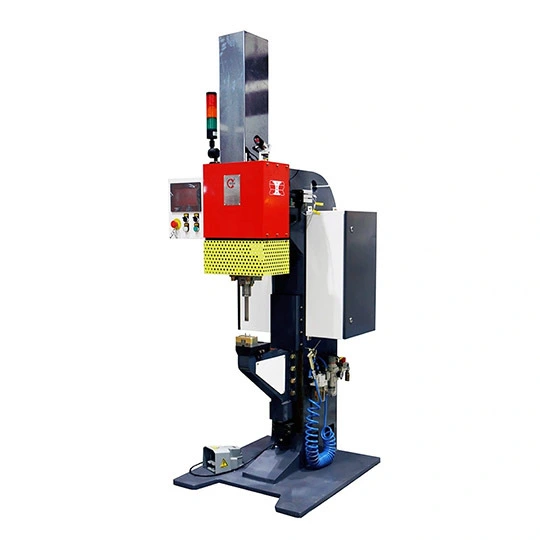
In high-volume manufacturing environments where lightweight construction, high joint strength, and process consistency are paramount, Self Pierce Riveting (SPR) has emerged as a reliable and efficient joining technology. As globalization and materials innovation drive the adoption of advanced alloys and multi-material assemblies, understanding SPR’s principles, advantages, and integration best practices is crucial for OEMs, automation integrators, and factory decision-makers seeking to optimize production lines.
At Heron Welder, a global leader in industrial welding and metal-joining systems, we engineer state-of-the-art SPR machines and automation solutions that deliver precision, repeatability, and throughput for automotive, aerospace, electrical, and white goods manufacturing.
What Is Self Pierce Riveting (SPR)?
Self Pierce Riveting is a cold-form joining process that mechanically locks materials together by driving a semi-tubular rivet through layered sheets without penetrating the bottom surface. Unlike traditional riveting or weld-based joining, SPR does not require pre-drilled holes or consumable heat sources, making it ideal for joining dissimilar metals like aluminum and high-strength steels common in lightweight structures.
The riveting process creates a mechanical interlock between layers by forming a controlled material flare or “upset,” securing joints with excellent shear and tensile strength. This makes SPR a preferred choice where weldability is limited, coatings must be preserved, and heat distortion is a concern.
How SPR Works: Key Principles
1. Rivet Geometry and Materials
SPR rivets are typically made from high-strength aluminum, steel, or stainless steel, selected based on the application’s mechanical and corrosion requirements. Semi-tubular design allows controlled deformation during the joining cycle.
2. Process Stages
A typical SPR cycle includes:
-
Positioning the Rivet: A rivet is aligned above the overlapping material stack.
-
Punch Penetration: A reciprocating punch drives the rivet through the top sheet(s) without breaching the bottom sheet.
-
Rivet Expansion: The rivet’s tubular section flares outward against a contoured anvil, creating a mechanical lock between layers.
-
Joint Formation: The final geometry results in a robust joint with a smooth upper surface and no protrusion beneath.
3. Machine Parameters
Critical parameters influencing joint quality include:
-
Punch force and speed
-
Rivet feed precision
-
Anvil profile
-
Material stack tolerances
-
Clamping force
Optimizing these factors ensures consistent joints and extends tooling life.
Key Industrial Applications
SPR is versatile and has been adopted across multiple sectors:
Automotive
The automotive industry’s push toward lightweight structures has made SPR an essential joining technique. Aluminum to steel and aluminum to aluminum joints in body-in-white, door modules, and battery enclosures benefit from SPR’s low heat input and high strength.
Aerospace
Aircraft interiors and secondary structures often use SPR to join thin gauge and lightweight components where heat input must be carefully controlled to avoid distortion.
Electrical and Electronics
Joining sheet metal enclosures, frames, and brackets without compromising coatings or electrical continuity underscores SPR’s value in electrical equipment manufacturing.
White Goods and Appliances
High throughput assembly of washer/dryer cabinets, refrigerators, and HVAC housings leverage SPR for rapid, repeatable joint formation with minimal rework.
SPR vs. Traditional Joining Methods
Understanding how SPR compares with resistance welding, adhesives, and mechanical fasteners helps engineers make informed decisions.
SPR vs. Resistance Welding
| Feature | SPR | Resistance Welding |
|---|---|---|
| Heat Input | Minimal | High |
| Material Combinations | Excellent | Limited (weldable materials only) |
| Surface Finish | Preserved | Potential discoloration |
| Joint Strength | High mechanical strength | High electrical/structural strength |
| Cycle Time | Fast | Fast |
SPR excels when materials are dissimilar or coatings must be preserved. Resistance welding is superior for weldable alloys where metallurgical fusion is desired.
SPR vs. Adhesives
Adhesives can bond complex assemblies but require cure times and surface prep. SPR provides instant mechanical locking with minimal surface preparation and no cure time, making it suitable for high-speed automated lines.
SPR vs. Bolted Fasteners
Bolts and screws add cost, inventory complexity, and require hole preparation. SPR delivers flush, permanent joints that reduce part counts and simplify supply chains.
Integrating SPR into Automated Production Lines
For factories pursuing Industry 4.0 readiness, integrating SPR systems with robotics and controls can unlock significant productivity gains.
Robotic SPR Cells
Robots equipped with SPR tooling provide flexible positioning, repeatability, and the ability to handle complex geometries. Collaborative robots (cobots) can also perform SPR in low-volume or mixed product lines.
Vision and Force Monitoring
Real-time monitoring systems that integrate torque/force feedback ensure each joint meets quality criteria. SPC (Statistical Process Control) data can feed MES systems for traceability and continuous improvement.
Tool Changers and Multi-Axis Heads
Advanced SPR cells can switch tooling heads or orientations to handle diverse joint locations within a single cycle, reducing floor space and changeover time.
Best Practices for SPR Success
Achieving consistent high-quality joints requires attention to design and process variables:
Material Stack Design
-
Identify material combinations and thicknesses.
-
Validate that the bottom sheet will not be pierced.
-
Consider coatings and corrosion resistance.
Rivet and Anvil Selection
-
Match rivet material and geometry to stack conditions.
-
Use anvil profiles that control material flow for desired flare.
Process Validation
-
Run sample trials to set optimized punch force, speed, and dwell time.
-
Monitor joint quality with non-destructive testing (NDT) where applicable.
Routine Maintenance
-
Inspect tooling for wear.
-
Replace worn punches/anvils to maintain joint consistency.
-
Calibrate force sensors and controllers.
Why Choose Heron Welder for SPR Solutions
At Heron Welder, our comprehensive portfolio of Self Pierce Riveting systems and automation support helps manufacturers achieve:
-
Superior joint quality through precision-engineered riveting heads and controls
-
Scalable automation integrating SPR with robotics and plant control systems
-
Customized solutions tailored to application specifics and throughput goals
-
Service and support excellence spanning installation, training, and optimization
From standalone SPR machines to fully automated production cells, Heron delivers systems that drive uptime, repeatability, and throughput.
FAQs About Self Pierce Riveting
1. Can SPR join dissimilar materials like aluminum and steel?
Yes. SPR is especially effective for aluminum-to-steel joints where welding is challenging or undesirable due to heat-sensitive coatings.
2. Does SPR damage surface coatings?
SPR generally preserves surface coatings better than heat-based methods, as it introduces minimal thermal input and concentrates deformation locally.
3. Is SPR suitable for high-volume production?
Absolutely. With cycle times measured in seconds and compatibility with robotics, SPR is ideal for automated, high-volume manufacturing.
4. What is the typical inspection method for SPR joints?
Common techniques include cross-sectional analysis, optical inspection, and force/torque monitoring during the riveting cycle.
5. Can SPR be used in curved or complex geometries?
Yes, with proper fixturing and robot programming, SPR can be applied to contoured panels and assemblies.
Next Steps: Optimize Your Joining Processes with Heron
Ready to elevate your manufacturing with robust, high-speed Self Pierce Riveting and automation? Contact Heron Welder today to request a quote or consult with our application engineers. We’ll help you design and implement tailored SPR solutions that meet your production goals and quality standards.
Request a consultation or custom solution now and move your factory toward smarter, stronger joining technologies.

 English
 Magyar
 Arabic
 French
 Spanish
 Portuguese
 Deutsch
 Turkish
 Italiano
 Russian
 Romaian
 Portuguese (Brazil)
 Greek
Greek