
The Blueprint of Style: How Trends Reshape Production
The production floor of a forward-thinking men's sunglasses manufacturer is a dynamic environment, constantly adapting not just to orders, but to the evolving language of style. Current design trends are not merely sketches; they are concrete directives that reshape tooling, material sourcing, and assembly processes. Today, several key movements are actively driving manufacturing priorities and challenging factories to innovate.
The Dominance of Bold, Architectural Shapes
A significant shift from the slim metal styles of the past decade, the current demand is for confident, geometric frames. Think oversized squares, robust aviators with double bridges, and shield-style lenses with assertive curvature. This trend directly impacts the factory’s tooling and material departments. For acetate frames, it requires thicker block materials and revised milling techniques to handle the increased mass without internal stress. The polishing and tumbling stages take longer to achieve a flawless finish on such prominent surfaces. For metal frames, it demands stronger, often heavier-gauge alloys and reinforced welding or soldering points at the hinges and bridges to ensure structural integrity. The trend toward architectural design is, fundamentally, a trend toward more material and more robust construction, altering production timelines and material yield calculations.
The Technical Detailing and Hybrid Construction
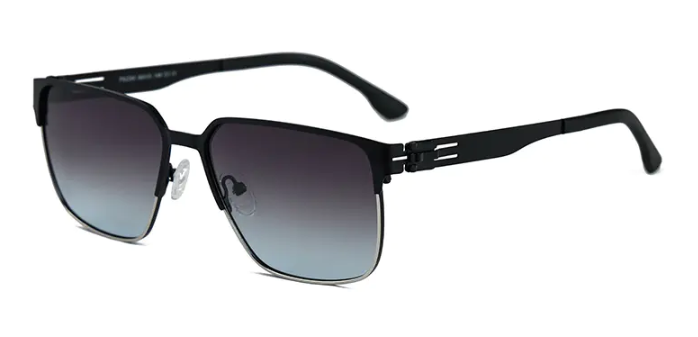
Modern men’s styles frequently blend materials and incorporate functional detailing. A metal core wire wrapped in acetate, or a nylon frame with integrated silicone nose pads and temple tips, is increasingly common. This hybrid approach complicates the assembly line. Instead of a single material process, production must synchronize multiple supply chains (acetate, metal, silicone) and develop new assembly jigs. Techniques like ultrasonic welding for embedding metal into plastic, or precise insert molding for silicone components, become essential skills on the factory floor. Furthermore, the trend for "tech" details—such as integrated screwless hinges, adjustable nose pads, and branded metal accents—requires investment in smaller, more precise micro-tooling and a higher level of skilled manual assembly and final adjustment.
Advanced Lens Applications and Customization
The trend is no longer just about dark tint. Factories are seeing rising demand for complex lens technologies integrated into fashion-forward frames. This includes precise gradient tints (darker at the top, lighter at the bottom), flash mirror coatings in colors like blue, gold, or silver, and of course, polarized filters as a standard expectation for quality. Each of these features adds a layer to the production process. Applying a perfect gradient requires specialized masking techniques in the coating chamber. A durable flash mirror coating needs a perfectly clean base lens and specific vapor deposition parameters. Offering these options means a factory must manage a much more complex inventory of lens blanks and coating materials, moving from bulk standardization towards flexible, batch-based production to accommodate short runs of varied specifications.
These trends illustrate that manufacturing is intrinsically linked to design. A modern factory’s capability is measured not just by its output volume, but by its agility—its ability to retool for new shapes, master multi-material assembly, and execute sophisticated lens treatments. This responsiveness transforms passing fashion trends into tangible, well-made products that define the market.

 English
 Magyar
 Arabic
 French
 Spanish
 Portuguese
 Deutsch
 Turkish
 Italiano
 Russian
 Romaian
 Portuguese (Brazil)
 Greek
Greek