
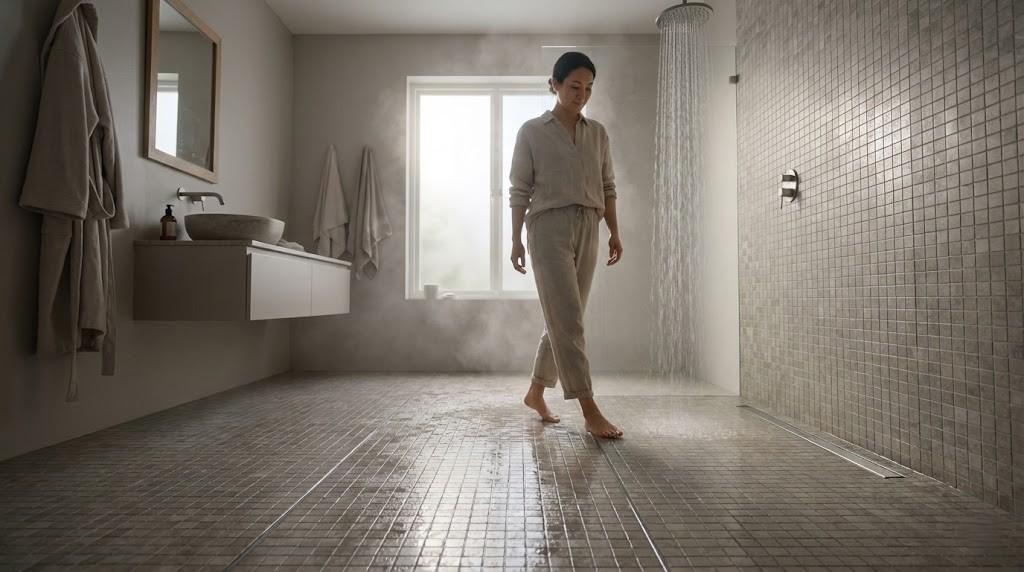
The bathroom stands as a unique architectural challenge, a space where the essential elements of water, sanitation, and personal care converge. In the context of many Asian homes, this challenge is intensified by the widespread adoption of the wet room design. This elegant solution, which eschews shower trays and curtains for a fully tanked, gently sloped floor, demands a flooring material that can perform under constant exposure to moisture. A single misstep on a slippery surface can lead to serious injury, transforming a place of hygiene and respite into one of hidden danger.
Therefore, the selection of bathroom flooring transcends aesthetics; it is a foundational safety decision. This handbook is designed to empower homeowners, designers, and builders with the knowledge to navigate the often-confusing world of tile slip resistance. We will focus on the practical application of technical data, the strategic use of mosaic tiles, and the invaluable role of a trusted ceramic tile shop in sourcing materials that ensure both beauty and security underfoot.
Deconstructing the Wet Room Environment
To select the appropriate tile, one must first fully appreciate the environment it will endure. A true wet room bathroom is, by design, a space where water is intended to flow freely across the entire floor to a central or linear drain. This means the floor is not merely exposed to occasional splashes but is regularly drenched. Coupled with the high ambient humidity common in tropical and subtropical climates, evaporation is slow, leading to prolonged wetness.
Furthermore, this water is seldom pure. It is laden with soaps, oils, shampoos, and conditioners—substances engineered to reduce surface tension and increase lubricity. This "contaminated water" creates a far more hazardous condition than clean water alone. A tile that feels secure under a tap's flow may become treacherously slick when coated with a film of body wash. This reality necessitates a tile with a robust and textured surface that can penetrate this film to maintain grip.
The Slip Resistance Lexicon: Key Terms Decoded
Navigating product specifications requires fluency in the language of testing. Here are the critical terms explained for practical application:
-
Dynamic Coefficient of Friction (DCOF): This is the current industry standard measurement for wet interior floors. It measures the friction as an object is already in motion across a wet surface. The Tile Council of North America recommends a DCOF AcuTest value of 0.42 or greater for level interior spaces expected to be walked on when wet. Treat this as your baseline qualifying number.
-
R-Rating (DIN 51130): This German standard is an inclined ramp test performed with an oil-coated surface and a person in standard footwear. The steeper the incline the person can walk on without slipping, the higher the R-value (R9-R13). For a residential wet room where bare feet are common, an R11 rating is strongly recommended as a minimum. This indicates a tile with proven performance on a steep, oily incline—a rigorous test.
-
Barefoot Rating (DIN 51097): This test is arguably more relevant for bathrooms, as it uses a soapy solution and a barefoot test subject on an inclined ramp. Tiles are graded A, B, or C, with C offering the highest slip resistance for barefoot, wet areas. When asking about mosaic tiles for your shower floor, inquire if they carry a DIN 51097 Class B or C rating.
-
Pendulum Test Value (PTV): This British Standard test (BS 7976) uses a swinging, rubber-shod arm to simulate a slipping foot. A PTV of 36+ is considered low slip potential for public areas—a robust target for a domestic wet room seeking premium safety.
The Unmatched Efficacy of Mosaic Tiles in Wet Applications
Mosaic tiles are not merely a stylistic choice for wet rooms; they are a biomechanically superior one. Their effectiveness stems from a principle known as "contact patch disruption." A large-format tile creates a vast, uninterrupted plane where a water film can form, significantly reducing the contact friction of a bare foot. Mosaics, through their numerous grout joints, shatter this plane.
Each grout line acts as a miniature water channel and, more importantly, a tactile ridge. As the foot makes contact, these ridges provide hundreds of points of positive grip, interrupting a potential slip. The grout itself, especially a sanded cementitious grout, offers a textured, high-friction surface. This makes a properly installed field of mosaic tiles inherently safer than a single sheet of material with an equivalent surface finish. For the primary wet zone, a mosaic is often the wisest default selection.
Strategic Material Choices for Lasting Safety
The mosaic format provides the macro-texture; the tile material provides the essential micro-texture.
-
Anti-Slip Porcelain: The premier choice. Modern porcelain can be pressed with textured molds or have an abrasive grit fired into the glaze (known as a carborundum finish). This creates a consistently rough, highly durable surface that is easy to clean and impervious to water. A high-quality ceramic tile shop will have a dedicated section for these "anti-slip" or "traction" floor tiles, often in mosaic sheets for easy installation.
-
Natural Stone with a Textured Finish: Stone mosaics like flamed granite, sandblasted limestone, or split-face slate offer exceptional natural grip. The finish is integral to the stone, not a surface coating, so it won't wear off. However, their natural porosity requires a penetrating sealer, which must be carefully selected to not create a slippery film. Re-sealing is a mandatory part of long-term maintenance.
-
Glazed Ceramic with Matte/Textured Finish: A viable, often more affordable option. The key is ensuring the glaze is specifically formulated for floor use. A high-quality matte glaze will have a slight tooth or grain to it. Always check the slip ratings and physically test a wet sample. Avoid any glazed tile with a reflective or shiny surface for floor applications.
The Critical Synergy of Design, Installation, and Maintenance
Safety is a system, not just a product. A tile's rated performance can only be achieved with correct installation and care.
-
Design Integration: Safety need not be obtrusive. Use a high-traction mosaic tile in the shower area and main floor, but carry a similar color or tone onto the walls with larger, complementary tiles. This creates visual harmony. Many suppliers offer matching field tiles and mosaic listellos or inserts from the same series, a coordination service a good ceramic tile shop can facilitate.
-
Installation Imperatives: The installer must create a perfectly even, correctly sloped substrate (a minimum 1:60 fall to the drain). Any depressions will cause water pooling. The grout joint width should be a minimum of 3mm for floor mosaics to ensure the grout grid is substantial enough to function as a safety feature. Using a epoxy or high-performance polymer grout will prevent moisture absorption and mold growth within the grout lines, preserving the system's integrity and hygiene.
-
Informed Procurement: Your journey should begin with research and end with a detailed conversation at a specialist ceramic tile shop. Bring your bathroom layout. Discuss your household's needs. Ask to see test certificates for the tiles you like. A responsible retailer will not only provide this information but will also guide you away from inappropriate choices, such as a beautiful but slippery glass mosaic intended for walls.
By synthesizing this knowledge—understanding the harsh wet room environment, interpreting technical ratings, selecting the synergistic mosaic format and appropriate material, and ensuring quality installation—you move beyond guesswork. You engineer a floor that is confidently safe. This informed approach transforms your bathroom into a true sanctuary, where the foundation is as secure as it is beautiful, ensuring peace of mind with every step for years to come.

 English
 Magyar
 Arabic
 French
 Spanish
 Portuguese
 Deutsch
 Turkish
 Dutch
Dutch
 Italiano
 Russian
 Romaian
 Greek
Greek