
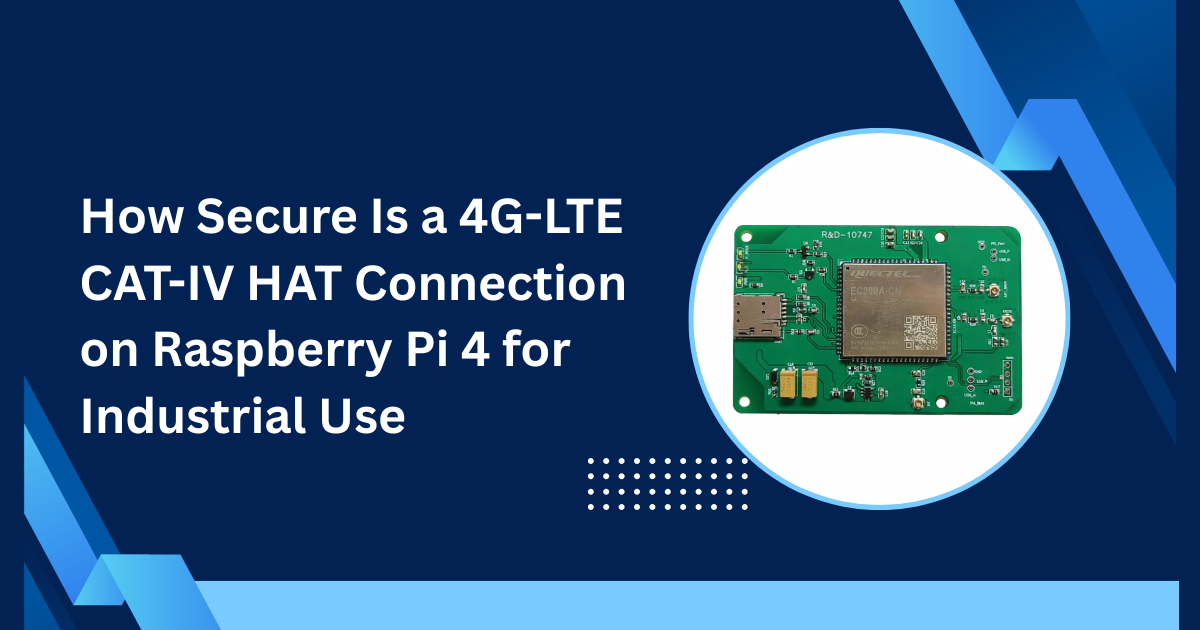
Industrial systems rely on secure and stable connectivity. Many companies now deploy the 4G-LTE CAT-IV HAT for Raspberry Pi4 to enable remote monitoring and control. This setup provides wide-area connectivity without wired infrastructure.
However, security remains a critical concern. Industrial networks handle production data, machine controls, and sometimes safety systems. A compromised connection can disrupt operations and cause financial loss.
This article evaluates the security of a Raspberry Pi4 with CAT-IV HAT from a technical perspective. It covers LTE security features, device vulnerabilities, threat models, mitigation techniques, and measurable risk factors.
Understanding the Architecture
1. Hardware Components
A typical setup uses a Raspberry Pi 4 board paired with a 4G-LTE CAT-IV HAT modem, SIM card, and external LTE antennas. The HAT connects via USB or UART, serving as the cellular modem, while the Raspberry Pi manages the operating system and applications.
2. Network Flow
Data from applications on the Raspberry Pi passes through the Linux network stack, LTE modem firmware, and cellular tower, then into the carrier's core network before reaching the internet or private backend. Each step has unique security and performance considerations.
Built-In LTE Security Features
4G LTE includes several security mechanisms by design.
1. SIM-Based Authentication
Each LTE device relies on a SIM card containing unique credentials. The carrier verifies these before granting network access, ensuring only authorized devices connect. This mechanism effectively prevents unauthorized devices from joining the network or accessing sensitive resources.
2. Air Interface Encryption
LTE encrypts data transmitted between the modem and base station using standardized cryptographic algorithms, such as AES. This encryption safeguards communications against interception over the air, protecting sensitive information from eavesdroppers and maintaining confidentiality during wireless transmission.
3. Integrity Protection
LTE implements integrity protection for control plane messages, ensuring they cannot be tampered with without detection. This prevents attackers from modifying signaling messages, preserving the reliability and security of network operations and reducing the risk of malicious interference.
4. Network Isolation Options
Carriers can provide private APNs to isolate industrial or sensitive devices from the public internet. This network segregation minimizes exposure to scanning, automated attacks, and other external threats, offering a secure, controlled communication environment for critical systems.
Security Strength of LTE Compared to Wi-Fi
Many industrial deployments previously relied on Wi-Fi. LTE offers several security advantages:
1. SIM-Based Authentication
LTE uses SIM cards for device authentication, ensuring that only registered subscribers can access the network. Wi-Fi relies on passwords or pre-shared keys, which can be easily shared, guessed, or intercepted, making LTE authentication far more secure and reliable.
2. Advanced Encryption
LTE encrypts both user data and signaling messages using strong algorithms like AES and SNOW 3G. Wi-Fi, even with WPA3, depends on local configurations, making it vulnerable to weak passwords, misconfigurations, or attacks on older protocols like WPA2.
3. Mutual Network Validation
In LTE, both the device and the network authenticate each other, preventing rogue base stations from impersonating legitimate networks. Wi-Fi rarely verifies access points, allowing attackers to set up fake hotspots to capture sensitive data.
4. User Privacy Protection
LTE protects subscriber identities by transmitting temporary identifiers instead of permanent IMSI values, reducing the risk of tracking. Wi-Fi broadcasts MAC addresses during connections, enabling attackers to track devices or monitor user movement across networks.
5. Centralized Security Management
LTE networks are managed by operators, allowing consistent enforcement of security policies and timely updates. Wi-Fi networks, especially home or public hotspots, rely on manual updates and may remain vulnerable to outdated firmware, weak configurations, and network attacks.
Security Weaknesses to Consider
Despite strong built-in features, LTE and Raspberry Pi deployments present real risks.
1. No Automatic End-to-End Encryption
LTE encrypts data only over the radio interface between the device and the carrier network. Once traffic leaves the carrier core, it may traverse unencrypted networks. Without additional protections like TLS or VPN, sensitive data can be intercepted or modified. Developers should always implement application-layer encryption for confidential communications.
2. Exposure to Public IP Space
Many carriers provide devices with public IP addresses. This exposes Raspberry Pi devices directly to the internet, allowing attackers to scan and detect open ports. Misconfigured services or default credentials can become entry points for unauthorized access, making proper firewall and network configuration essential.
3. Rogue Base Stations
Sophisticated attackers can set up fake LTE base stations, known as IMSI catchers or stingrays, to intercept or manipulate traffic. These devices may attempt to downgrade connections to weaker security modes. While such attacks are rare, research and field reports show they are possible in high-risk environments.
4. Device-Level Weaknesses
The Raspberry Pi 4 is not an industrial hardened controller by default. It lacks:
-
Secure boot enforcement
-
Built-in hardware key storage
-
Tamper detection
Physical access increases risk significantly.
Operating System Risks
The operating system (OS) is a critical component in determining the security posture of Raspberry Pi-based systems. Even with secure hardware and network connectivity, vulnerabilities in the OS can expose the device to attacks. Engineers must understand these risks to implement proper defenses.
1. Default Services
Many Raspberry Pi distributions, including Raspberry Pi OS, enable default services such as SSH, VNC, or web servers. If these services use default credentials or weak passwords, they become immediate targets for attackers. Regularly disabling unnecessary services and enforcing strong authentication is essential to reduce exposure.
2. Outdated Packages
Raspberry Pi OS and other Linux distributions rely on a variety of software packages. Without timely updates, these packages may contain known security vulnerabilities. Attackers frequently exploit such weaknesses using automated scanning and exploitation tools. Maintaining an up-to-date system is critical for long-term security.
3. Third-Party Applications
Industrial or IoT applications installed on the Raspberry Pi can introduce vulnerabilities. Poorly coded third-party software may lack input validation, allowing buffer overflows, command injection, or remote code execution. Security reviews and running software in isolated environments can mitigate these risks.
Industrial Threat Scenarios
1. Remote Intrusion Attempt
An attacker scans IP ranges assigned to cellular devices. The attacker finds an open SSH port. Weak credentials allow login access. The attacker installs malware.
Mitigation:
-
Disable password authentication
-
Use SSH keys
-
Restrict IP ranges
2. Data Interception
A telemetry system sends sensor data without TLS encryption. An attacker intercepts backend traffic outside the LTE radio link. Sensitive operational data becomes exposed.
Mitigation:
-
Enforce HTTPS or MQTT over TLS
-
Validate server certificates
3. Denial of Service
An attacker floods the public IP address of the device. The cellular link saturates. Monitoring data stops flowing.
Mitigation:
-
Use private APN
-
Configure firewall rules
-
Apply rate limiting
Security Best Practices for Industrial Deployment
Security depends on configuration discipline.
1. Use VPN Tunnels
Implement site-to-site or device-to-cloud VPNs to provide encrypted transport beyond LTE. VPNs protect data after it leaves the carrier network, ensuring end-to-end confidentiality. Common choices include WireGuard, IPsec, and OpenVPN. VPNs also allow centralized access control and reduce exposure to public IP scanning.
2. Enforce TLS Everywhere
All application-layer traffic should use TLS 1.2 or higher, including HTTP APIs, MQTT messaging, and database connections. Disable outdated protocols such as SSL or TLS 1.0/1.1. Enforcing strong cipher suites prevents eavesdropping, man-in-the-middle attacks, and data tampering.
3. Harden the Linux System
The Raspberry Pi OS must be hardened to reduce attack surfaces. Essential steps include: disabling unused services, changing default passwords, enabling automatic security updates, and configuring firewall rules using iptables or nftables. This reduces the risk of unauthorized access and malware propagation.
4. Restrict Network Exposure
Minimize network exposure by blocking all inbound traffic by default and allowing only required outbound connections. For LTE-connected Raspberry Pi devices, this prevents attackers from reaching exposed ports and limits attack vectors to necessary services only.
5. Enable Logging and Monitoring
Logging is critical for detecting and responding to attacks. Track login attempts, network connections, service restarts, and system changes. Forward logs to a central secure server for analysis. Real-time monitoring allows rapid detection of anomalies, enabling proactive defense.
Performance and Encryption Overhead
Security adds computational overhead. The Raspberry Pi 4 uses a quad-core ARM Cortex-A72 processor. It handles encryption tasks efficiently.
Testing shows that a Raspberry Pi 4 can maintain over 100 Mbps throughput using WireGuard under optimized conditions. This aligns well with CAT-IV LTE maximum speeds of 150 Mbps downlink.
CPU utilization increases during encryption. However, industrial telemetry rarely consumes full bandwidth. The performance impact remains manageable.
Industry Statistics and Risk Data
Industrial cybersecurity reports indicate growing risk:
-
Over 40% of industrial organizations reported at least one network breach in recent surveys.
-
IoT devices account for nearly 30% of observed enterprise cyber incidents.
-
The average cost of industrial downtime exceeds $250,000 per hour in large facilities.
These figures highlight the importance of layered security.
Cellular connectivity reduces some risks compared to open internet broadband. However, misconfigured IoT devices remain a primary attack vector.
Comparing 4G LTE with 5G for Industrial Security
Some organizations consider 5G as a replacement. 5G introduces improved encryption and mutual authentication features.
However:
-
4G LTE already uses strong AES-based encryption
-
Now industrial threats target device misconfiguration
-
Proper system design matters more than radio generation
A properly secured Raspberry Pi4 with CAT-IV HAT can meet industrial requirements when configured correctly.
Conclusion
The Raspberry Pi4 with CAT-IV HAT provides strong LTE authentication and radio encryption, protecting against many casual attacks. Industrial security depends on proper system configuration, including OS hardening, end-to-end encryption, and access control. With disciplined architecture, monitoring, and management, this setup becomes a reliable and secure platform for industrial IoT deployments, ensuring safe and robust communication.

 English
 Arabic
 French
 Spanish
 Portuguese
 Deutsch
 Turkish
 Dutch
Dutch
 Italiano
 Russian
 Romaian
 Portuguese (Brazil)
 Greek
Greek