
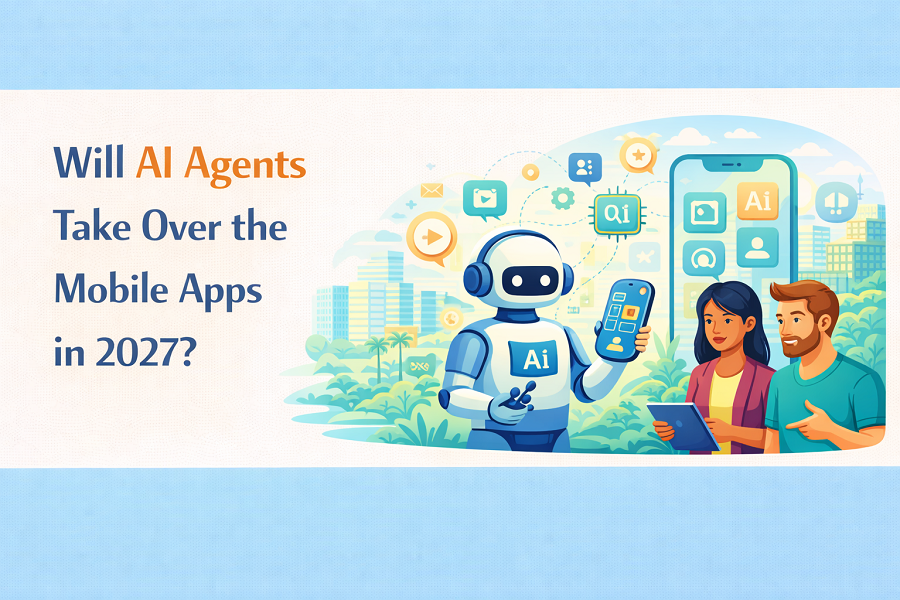
For years, mobile applications followed a predictable structure. Users opened an app, tapped through menus, completed tasks, and closed it again. The interaction was linear and controlled entirely by human input.
But something subtle has begun to change.
Instead of waiting for instructions, apps are starting to act. They suggest actions before users ask, automate repetitive workflows, and even communicate with other systems independently. At the center of this transformation lies a new concept gaining momentum across the technology industry: AI agents.
By 2027, many experts believe AI agents may fundamentally reshape how mobile experiences work — raising an important question for developers, businesses, and users alike: are traditional apps evolving into intelligent systems capable of operating on our behalf?
Understanding what AI agents actually are
The term “AI agent” is often misunderstood. Unlike basic automation or chatbots, AI agents operate as autonomous digital entities capable of perceiving context, making decisions, and executing actions toward defined goals.
Key characteristics of AI agents include:
-
Persistent awareness of user preferences.
-
Ability to analyze data continuously.
-
Decision-making based on real-time conditions.
-
Interaction with external systems without constant supervision.
Rather than functioning as passive tools, AI agents behave more like digital assistants embedded directly into software ecosystems.
Industry analysts describe this shift as a move from “interface-driven computing” toward “intent-driven computing,” where users define goals rather than individual steps.
Why traditional mobile app design is facing disruption
The traditional app model relies heavily on navigation structures — menus, buttons, and workflows guiding users through predefined actions. AI agents challenge this structure by reducing the need for manual navigation.
For example:
-
Instead of opening multiple apps to plan travel, an AI agent could coordinate bookings automatically.
-
Health apps may monitor wearable data continuously and initiate alerts or appointments without user prompts.
-
Financial applications could analyze spending patterns and adjust budgets proactively.
Research indicates that users increasingly prefer simplified interactions. Surveys suggest that over 65% of consumers favor automated recommendations when they reduce complexity without sacrificing control.
This preference creates pressure on developers to rethink interface design entirely.
The role of artificial intelligence advancements in accelerating agent adoption
Recent breakthroughs in large language models, reinforcement learning, and contextual reasoning have made AI agents more capable than earlier automation tools.
Modern AI systems can:
-
Understand natural language with greater accuracy.
-
Learn from user behavior patterns.
-
Integrate across multiple platforms simultaneously.
Industry forecasts predict that AI-powered automation could handle a significant percentage of routine digital tasks within the next few years.
OpenAI CEO Sam Altman has suggested that AI systems will increasingly “act as collaborators rather than tools,” highlighting a broader shift toward agent-based computing.
Are AI agents replacing apps — or redefining them?
Despite growing excitement, the future may not involve AI agents replacing apps entirely. Instead, many experts believe apps will evolve into platforms hosting intelligent agents.
This hybrid model combines traditional user interfaces with autonomous functionality:
-
Users retain control when needed.
-
Agents handle repetitive or complex tasks automatically.
-
Interfaces become conversational rather than menu-driven.
This evolution mirrors earlier technological transitions. Just as smartphones transformed desktop computing without eliminating it, AI agents may reshape mobile experiences without making apps obsolete.
The challenges developers face in building agent-driven systems
Designing applications for AI agents introduces new technical and ethical challenges.
Key considerations include:
-
Ensuring transparency in automated decisions.
-
Preventing unintended actions caused by misinterpretation.
-
Maintaining user trust through clear control mechanisms.
-
Managing data privacy and security risks.
Studies indicate that trust remains one of the biggest barriers to widespread AI adoption. Users must feel confident that autonomous systems act responsibly and predictably.
Developers must balance automation with accountability, creating systems that assist without overwhelming users.
The economic implications of AI agents for businesses
AI agents may reshape business models by changing how users interact with services. If agents complete tasks automatically, traditional app engagement metrics such as screen time or session length may become less relevant.
Instead, businesses may measure success through:
-
Task completion rates.
-
User satisfaction scores.
-
Long-term retention driven by automation value.
Companies capable of integrating AI agents effectively could reduce customer friction significantly, improving conversion rates and loyalty.
Industry research suggests that automation-driven experiences can increase operational efficiency by up to 30%, making agent-based development financially attractive.
Ecosystems shaping how quickly AI agents evolve
Technology adoption rarely occurs uniformly. Regions combining strong research institutions, startup communities, and interdisciplinary collaboration often accelerate innovation.
Within such environments, mobile app development San Diego reflects broader experimentation with AI integration, healthcare technology, and advanced automation systems. Developers exposed to diverse industries explore new use cases for intelligent agents across sectors such as biotech, logistics, and defense technology.
This ecosystem-driven innovation influences how quickly agent-based systems transition from experimental to mainstream.
Ethical considerations shaping the future of AI-driven apps
As AI agents become more capable, ethical questions grow increasingly important.
Key concerns include:
-
Bias in algorithmic decision-making.
-
Transparency about automated actions.
-
User autonomy versus convenience.
Experts emphasize that successful adoption depends on responsible design principles ensuring that AI enhances human agency rather than replacing it.
A leading AI ethicist recently noted, “The goal is not to remove humans from decisions but to empower them with better tools.”
The evolving role of developers in an agent-driven future
Developers building for AI agents must adopt new skills, including:
-
Designing conversational interfaces.
-
Managing contextual data flows.
-
Integrating AI reasoning systems with traditional software architecture.
The shift requires developers to think less about static features and more about dynamic behavior — creating systems capable of adapting to changing user needs.
The future of mobile interaction: from apps to intelligent ecosystems
Looking toward 2027, the rise of AI agents suggests a future where mobile devices act as orchestration hubs for digital life. Instead of navigating dozens of apps manually, users may rely on intelligent systems coordinating tasks seamlessly across platforms.
Yet the core purpose of apps — delivering value through specialized functionality — remains essential.
Rather than disappearing, mobile applications may evolve into collaborative environments where AI agents and human users work together.
In this sense, the question is not whether AI agents will take over mobile apps, but how they will transform them — shifting the focus from interaction to intention and redefining what it means to use technology in a world where software increasingly anticipates our needs.

 English
 Magyar
 Arabic
 French
 Spanish
 Portuguese
 Deutsch
 Turkish
 Dutch
Dutch
 Italiano
 Russian
 Romaian
 Portuguese (Brazil)