
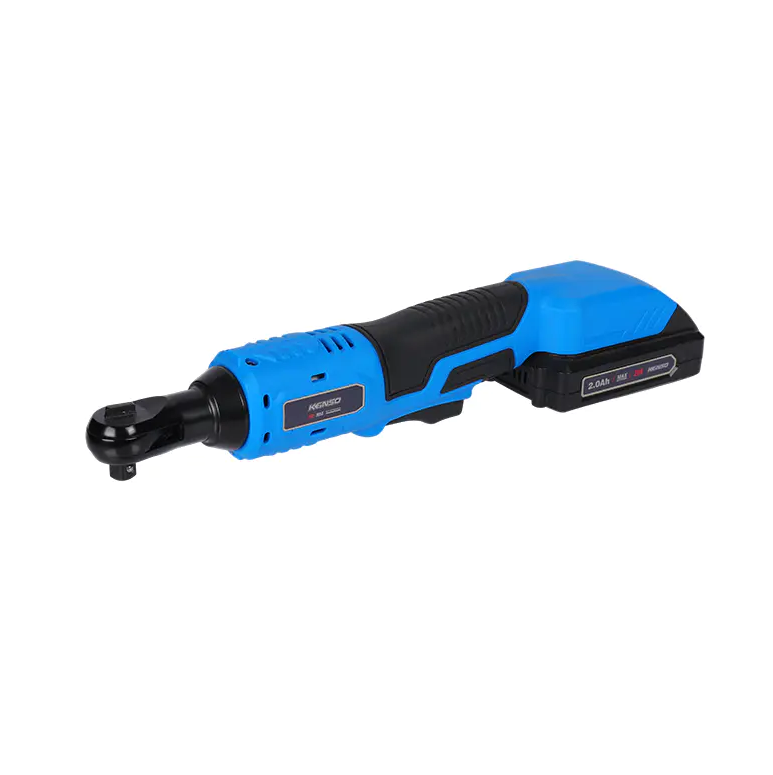
In automotive, machinery, and assembly work, countless fasteners must be installed and removed in tight spaces where swing space for a traditional ratchet handle is limited. The cordless ratchet wrench solves this persistent problem by combining the familiar ratcheting socket drive with compact electric power. This tool is engineered not for ultimate breaking torque, but for speed and accessibility, dramatically reducing fatigue and time spent on repetitive fastening tasks where a manual tool or bulkier impact wrench would be impractical or ineffective.
Defining the Tool's Niche: Power vs. Impact
It is crucial to distinguish this tool from an impact wrench. A cordless ratchet is designed for running down and backing out fasteners efficiently. It provides consistent rotational force (typically 35-100 Nm) at a relatively high speed, making it ideal for assembling components or removing already-loosened bolts. Its slim, low-profile head can access confined areas where an impact wrench's anvil mechanism cannot fit. An impact wrench, conversely, delivers sudden, high-torque impacts (hundreds of Nm) designed to break loose seized or overtightened fasteners. The ratchet is the finesse tool for speed and access; the impact is the brute-force tool for stubborn bolts.
Key Features and Ergonomic Design
Modern models prioritize a compact form factor. The head is only marginally larger than a high-quality manual ratchet, allowing it to fit into engine bays, around plumbing, and inside machinery frames. Brushless motors are now standard, offering more power and runtime in a smaller package with less heat generation. Variable speed triggers allow precise control for starting fasteners or working in delicate situations. Many feature a directional lever for forward/reverse and some include a built-in LED work light to illuminate dark workspaces—a highly valued feature. The balance and grip are designed for prolonged one-handed use, significantly reducing hand and wrist strain during all-day projects.
Optimizing Use and Battery System Integration
The true value is unlocked when integrated into a broader cordless ecosystem. Most cordless ratchets are part of a manufacturer's 12V or 18V/20V Max platform. For professional mechanics, using the same compact 12V battery that powers their drill, light, and inspection camera streamlines the workflow. Runtime is ample for a full day of intermittent use, with quick-swap batteries keeping the tool in action. It is perfect for tasks like interior trim work, electrical panel assembly, intake manifold bolts, or any scenario involving numerous fasteners in a row. It is not intended for final torqueing; a calibrated torque wrench should always be used for critical specifications.
Transforming Efficiency in Professional and DIY Settings
For professionals, this tool is a productivity multiplier, turning hours of manual ratcheting into minutes of powered work, directly impacting job throughput and reducing physical fatigue. For the serious DIY enthusiast, it brings a level of shop-like efficiency to the home garage, making complex projects like engine work or furniture assembly far less daunting. By eliminating the endless manual back-and-forth, it allows the user to focus on the task itself rather than the effort required. The cordless ratchet wrench has redefined what is possible in tight-quarter mechanics, establishing itself not as a luxury but as a fundamental tool for anyone who regularly turns a socket, saving time, effort, and frustration with every click of its trigger.

 English
 Magyar
 Arabic
 French
 Spanish
 Portuguese
 Deutsch
 Dutch
Dutch
 Italiano
 Russian
 Romaian
 Portuguese (Brazil)
 Greek
Greek