
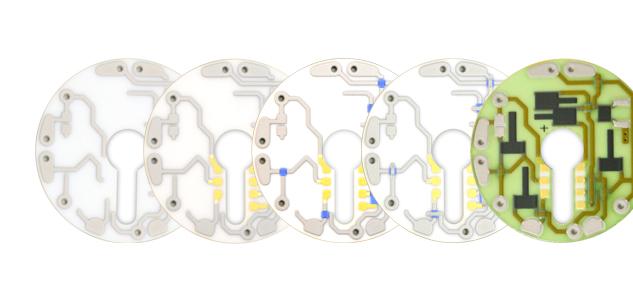
You might be familiar with standard printed circuit boards found in most electronics. However, some jobs require something more durable and compact. This is where thick film technology comes in. These boards are not just simple pieces of plastic with copper. They are built using layers of special pastes on a solid base, usually ceramic.
How they are made
The process starts with a ceramic substrate. This material is chosen because it handles heat very well. Manufacturers use a screen-printing process to apply different layers. These layers include conductive, resistive, and insulating pastes.
After each layer is printed, the board goes into a high-temperature furnace. This firing process turns the wet paste into a solid, permanent part of the board. Because these layers are printed directly onto the ceramic, the final product is very tough. It can survive in environments where a normal plastic board might melt or crack.
Designing a thick film hybrid circuit board allows engineers to combine high-performance materials into a single, compact unit.
Why people use them
One of the biggest reasons to choose this technology is size. You can integrate resistors directly into the board layers. This means you don't have to solder as many individual parts onto the surface. It saves a lot of space.
Reliability is another major factor. Since the components are literally baked into the board, they handle vibrations and shocks much better than standard parts. This makes them popular in cars, airplanes, and industrial machinery. They also stay stable even when the temperature changes rapidly.
Better heat management
Standard circuit boards struggle when they get too hot. Ceramic bases naturally pull heat away from the sensitive parts of the circuit. This keeps the electronics running longer without failing. If you are building something that needs to work in a hot engine or a heavy-duty power supply, this is a significant advantage. It ensures that the device remains functional even under heavy stress.
Conclusion
Choosing the right hardware depends on your specific needs for heat resistance and durability. If your project demands high reliability in a small package, this technology is often the best solution. At Hybrid-tek , we focus on providing these high-performance components for demanding industries.

 Magyar
 Arabic
 French
 Spanish
 Portuguese
 Deutsch
 Turkish
 Dutch
Dutch
 Italiano
 Russian
 Romaian
 Portuguese (Brazil)
 Greek
Greek