
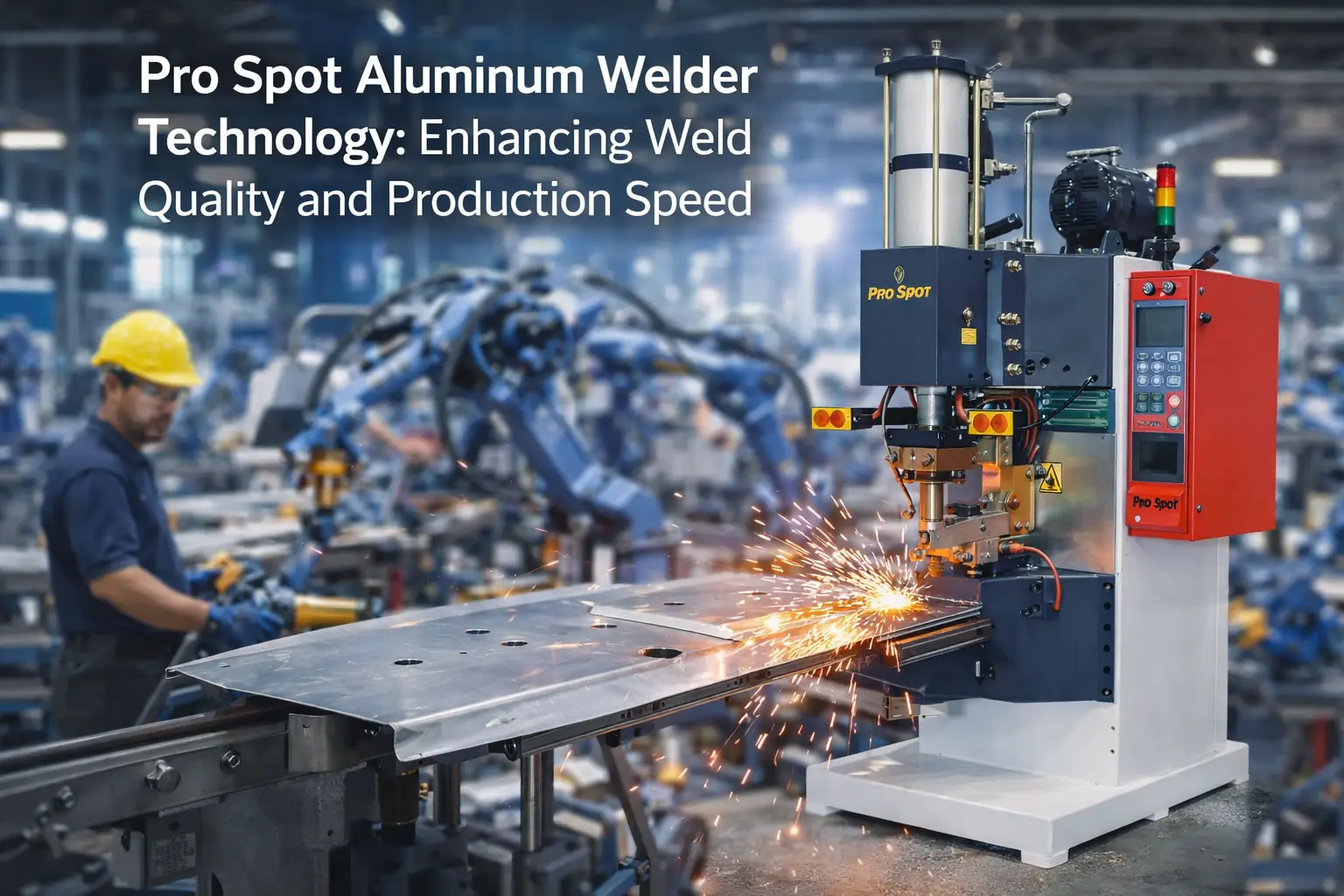
In today’s high-demand manufacturing environment, spot welding aluminium has become increasingly critical for industries like automotive, aerospace, electronics, and appliance production. With aluminium’s lightweight properties and exceptional corrosion resistance, manufacturers are turning to this metal to enhance product performance, efficiency, and sustainability. However, welding aluminium presents unique challenges compared to traditional steels. Understanding these nuances and leveraging the right technology is key to achieving reliable, high-quality welds.
Heron Welder provides advanced resistance welding solutions, including spot, projection, and MFDC welding machines, designed specifically to tackle the complexities of aluminium welding.
Understanding Spot Welding Aluminium
Spot welding is a type of resistance welding where two metal sheets are joined by applying heat generated from electric resistance at the contact point. The process involves:
-
Clamping the sheets between copper electrodes.
-
Passing a high electric current through the joint.
-
Melting and fusing the metal locally to create a nugget.
-
Cooling under pressure to form a solid bond.
Aluminium poses additional challenges due to its high thermal conductivity and oxidized surface layer, which can reduce weld penetration and increase electrode wear. Specialized welding equipment and proper process parameters are essential to address these issues effectively.
Key Applications of Aluminium Spot Welding
Industries leveraging aluminium spot welding include:
Automotive
Aluminium’s lightweight properties improve fuel efficiency and reduce emissions. Spot welding is widely used in car body panels, structural frames, and battery enclosures for electric vehicles.
Aerospace
Aircraft components benefit from aluminium’s high strength-to-weight ratio. Spot welding ensures structural integrity for fuselage panels, interior frameworks, and air ducts.
Electronics and Appliances
Aluminium enclosures, chassis, and heat sinks in electronic devices often require precise spot welding to maintain conductivity and structural performance.
Industrial Manufacturing
Machinery, storage tanks, and lightweight structures utilize spot welding to join aluminium sheets efficiently and reliably.
Challenges in Spot Welding Aluminium
-
High Thermal Conductivity: Aluminium dissipates heat quickly, requiring higher currents or longer welding times to achieve sufficient nugget formation.
-
Oxide Layer: Aluminium naturally forms a thin oxide film that has higher resistance, potentially preventing proper electrical contact. Pre-treatment or special electrode design is often required.
-
Electrode Wear: Standard electrodes may degrade faster due to the metal’s properties, necessitating durable materials such as copper-chromium alloys.
-
Dimensional Control: Aluminium’s soft surface is prone to indentation, so accurate electrode pressure control is crucial.
Best Practices for Spot Welding Aluminium
To achieve consistent and strong welds, manufacturers should consider the following:
1. Use MFDC (Medium-Frequency Direct Current) Welding Machines
MFDC spot welders deliver precise energy control and short weld cycles, which minimize heat spread and reduce electrode wear. Heron’s MFDC machines are optimized for aluminium’s unique characteristics.
2. Electrode Selection and Maintenance
Copper-chromium electrodes with contoured designs help maintain weld quality and reduce the risk of sticking or pitting.
3. Pre-Treatment of Surfaces
Light mechanical cleaning or chemical treatment removes the oxide layer, improving current flow and reducing weld defects.
4. Optimize Welding Parameters
Current, weld time, electrode force, and cooling cycles should be carefully calibrated for aluminium thickness and alloy type. Automation systems integrated with Heron’s welding controllers ensure repeatable, high-quality results.
5. Monitor Weld Quality
Using real-time monitoring and data logging ensures consistent nugget size and mechanical strength, reducing scrap and rework.
Spot Weld Aluminium vs. Steel: Key Differences
| Feature | Aluminium | Steel |
|---|---|---|
| Thermal Conductivity | High – heat dissipates quickly | Low – easier to localize heat |
| Oxide Layer | Thin, electrically resistant | Minimal impact |
| Electrode Wear | Higher, requires durable materials | Moderate |
| Weld Strength | Requires precise control | Easier to achieve |
| Applications | Lightweight, corrosion-resistant structures | General industrial and automotive |
Understanding these differences allows manufacturers to select the appropriate welding technology, process settings, and automation solutions.
Why Choose Heron Welder for Aluminium Spot Welding?
Heron Welder offers customized resistance welding solutions tailored to aluminium applications:
-
Advanced MFDC Spot Welders for controlled, precise energy delivery.
-
Automated Production Lines integrating welding, monitoring, and material handling.
-
Durable Electrode Designs for long-lasting performance.
-
Expert Support and Consultation to optimize welding parameters, reduce scrap, and improve throughput.
Our team collaborates with OEMs, automation integrators, and factory engineers to deliver solutions that meet the highest standards of quality and efficiency.
FAQs About Spot Welding Aluminium
Q1: Can all aluminium alloys be spot welded?
A: Most aluminium alloys can be spot welded, but some high-strength alloys require specialized electrodes and MFDC systems for optimal results.
Q2: How does MFDC technology improve aluminium spot welding?
A: MFDC welders provide precise, high-current pulses with controlled duration, minimizing heat spread, reducing distortion, and improving nugget formation.
Q3: What thickness range is suitable for aluminium spot welding?
A: Typically, sheets from 0.5 mm up to 6 mm can be spot welded effectively, depending on alloy type and equipment specifications.
Q4: How can electrode wear be minimized?
A: Using copper-chromium electrodes, proper force settings, and regular maintenance can extend electrode life.
Q5: Can spot welding aluminium be automated?
A: Yes, automated lines equipped with Heron welding controllers and robotic arms can achieve high-volume, repeatable, and high-quality welds.
Conclusion: Optimize Your Aluminium Welding with Heron
Mastering spot weld aluminium requires understanding the metal’s properties, selecting the right welding technology, and implementing best practices for electrodes, parameters, and automation. Heron Welder combines advanced MFDC welding machines, durable electrodes, and expert automation solutions to help manufacturers achieve consistent, high-strength aluminium welds.
Request a quote or consult with Heron today to customize your spot welding system and elevate your production efficiency with reliable, high-quality aluminium welds.

 Magyar
 Arabic
 French
 Spanish
 Portuguese
 Deutsch
 Turkish
 Dutch
Dutch
 Italiano
 Russian
 Romaian
 Portuguese (Brazil)
 Greek
Greek