
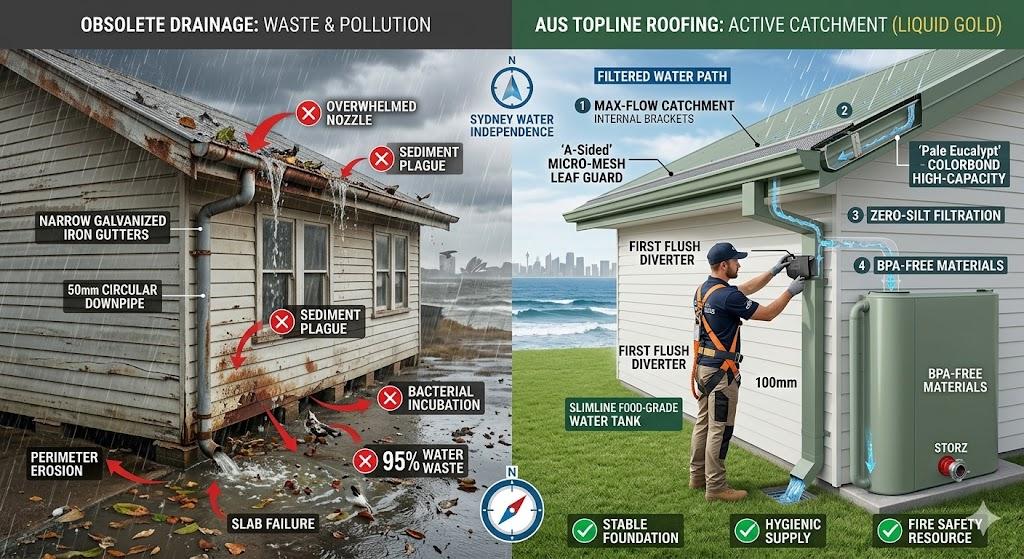
In 2026, water security has become a primary concern for Sydney homeowners. As utility costs rise and weather patterns become more unpredictable, the ability to capture and store every drop of rain that hits your roof is a massive financial advantage. However, many people view their water tank as the most important part of the system. In reality, the tank is only a storage vessel. The true "engine" of your water security is your roofline. Consequently, a professional gutter installation designed specifically for harvesting is the only way to ensure the water in your tank is plentiful, clean, and safe for your garden or home.
At Aus Topline Roofing, we build "Active Catchment" systems. In this 1,000-word guide, we explore how specialized guttering transforms your roof into a high-performance watershed and why precision engineering at the eave is the difference between "liquid gold" and a wasted resource.
1. The Physics of High-Yield Catchment
To maximize harvesting, your gutters must be perfectly calibrated for volume and velocity. Standard gutters often lose up to 20% of rainfall during "super-storms" because the water "overshoots" the gutter or the downpipes bottleneck.
Therefore, a harvesting-optimized installation utilizes "high-front" profiles and oversized 100mm downpipes. This ensures that even during a flash flood, the water is captured and moved toward the tank rather than spilling onto the ground. Following an upgrade to these high-flow specifications, your "yield" (the amount of water successfully collected) increases significantly. As a result, your tanks fill faster, providing you with a larger buffer during the dry Sydney months. Following this logic, your roof becomes a more efficient tool for self-sufficiency.
2. Water Quality: It Starts with Material Science
If you intend to use your harvested water for washing clothes, flushing toilets, or even filtered drinking water, the material of your gutters is critical. Many older gutters use lead-based solders or paints that can "leach" toxic chemicals into the water.
In 2026, we utilize "Tank Grade" materials. These are specialized Colorbond® steels and food-grade polymers that are chemically inert. They do not react with the water or release heavy metals. Consequently, the water entering your tank is as pure as possible. Furthermore, these materials are resistant to the microbial growth that can turn a water tank "sour." By choosing a clean-start gutter installation, you protect the health of your family and the longevity of your tank’s filtration system.
3. The "First Flush" and Debris Diversion
The first ten minutes of any rainstorm are the "dirtiest." The water washes away dust, bird droppings, and air pollution that has settled on your roof. If this enters your tank, it creates a layer of sludge at the bottom.
Modern harvesting systems integrate "First Flush Diversion" technology directly into the downpipe line. This works by diverting the initial, contaminated water into a separate chamber. Once that chamber is full, a ball-valve floats to the top, sealing the dirty water away and allowing the subsequent clean water to flow into the tank. Therefore, your gutters act as the first stage of a multi-level filtration system. Following this process, the water reaching your pump is clear and sediment-free. As a result, your pump lasts longer and your filters require less frequent replacement.
4. Preventing "Gutter Sludge" with High-Fall Engineering
Water that "pools" or sits stagnant in your gutters is a breeding ground for mosquitoes and bacteria. In many older Sydney homes, gutters have "sagged" over time, creating low points where water stays for days after a storm.
By opting for a precision gutter installation, you ensure a consistent "fall" toward the downpipes. We use laser-leveling technology to ensure there are zero stagnant zones. Consequently, the gutters dry out completely within an hour of the rain stopping. Furthermore, this prevents the buildup of "organic sludge" that can taint the smell of your harvested water. Following this high-level craftsmanship, you maintain a hygienic roofline that supports a healthy home environment.
5. Integrating High-Flow Rainheads and Leaf Sliders
A major bottleneck in rainwater harvesting is the point where the gutter meets the downpipe. Standard "droppers" can easily block with a single large leaf. In 2026, we utilize "Rainheads"—external boxes that provide a large "sump" for water to collect before entering the pipe.
These rainheads often include a "Leaf Slider"—a sloped mesh that allows water to pass through while physically ejecting leaves and twigs out of the system. Therefore, the debris never enters your downpipes. This is a vital component for maintenance reduction. As a result, you spend less time cleaning your tank’s inlet screens and more time enjoying your garden. Following a professional installation, these rainheads also act as an "overflow" point, ensuring that if your tank is full, the excess water is safely diverted away from your house foundation.
6. Sizing Your System for 2026 Storm Patterns
Sydney’s rainfall is becoming more erratic. We are seeing longer dry spells followed by incredibly intense "bursts." To harvest this water effectively, your gutters must be sized for the "Peak Flow."
Consequently, we perform a "catchment calculation" before every installation. We measure your roof's total surface area and calculate the gutter size needed to handle a "1-in-100-year" storm event. If your gutters are too small, you miss out on the most productive harvesting moments of the year. By choosing Aus Topline Roofing, you ensure your system is engineered for the reality of the 2026 climate. Following this data-driven approach, we maximize your collection potential during every rainfall.
7. Aesthetic Integration of Tanks and Pipes
Many homeowners hesitate to harvest water because they fear "ugly" tanks and bulky pipes. However, 2026 design trends emphasize "Seamless Sustainability." We match our downpipes and rainheads to your home's Colorbond® palette, making the infrastructure "disappear" against your walls.
Furthermore, we can install "Slimline" downpipes that hug the corners of your building. This ensures that your commitment to the environment doesn't compromise your home's curb appeal. As a result, you gain a high-performance system that looks like an intentional part of the architecture. Following this design philosophy, your home looks modern and remains highly functional.
8. Financial ROI: Beyond the Water Bill
The return on investment (ROI) for a harvesting-ready gutter installation is multi-faceted. First, there is the direct saving on your Sydney Water bill. Second, there is the increased value of your property. In 2026, "Green-Rated" homes with independent water security sell for a premium.
Therefore, the cost of the upgrade is an investment in your property's equity. Additionally, many local councils offer rebates or incentives for installing harvesting systems that meet certain efficiency standards. By working with a professional team, you ensure your system meets these criteria. As a result, you unlock financial benefits while doing your part for the Sydney basin's water health.
9. Fire Safety and Water Storage
For homes in bushfire-prone zones, a full water tank is a vital firefighting resource. Modern systems can be fitted with "Storz" fittings that allow the Rural Fire Service (RFS) to pump directly from your tank.
However, this water is only available if your gutters remain clear and intact during an ember attack. By combining fire-rated materials with harvesting technology, we provide a dual-purpose defense. Following a professional gutter installation, your home is prepared to fight fire and survive drought. Consequently, you achieve the ultimate level of property resilience.
10. Conclusion: The Future is Catchment
Ultimately, every roof in Sydney is a potential "private dam." The only thing standing between you and water independence is the quality of your drainage system. A professional, harvesting-optimized gutter installation turns a passive roof into an active resource.

 English
 Magyar
 Arabic
 Spanish
 Portuguese
 Deutsch
 Turkish
 Dutch
Dutch
 Italiano
 Russian
 Romaian
 Portuguese (Brazil)
 Greek
Greek