
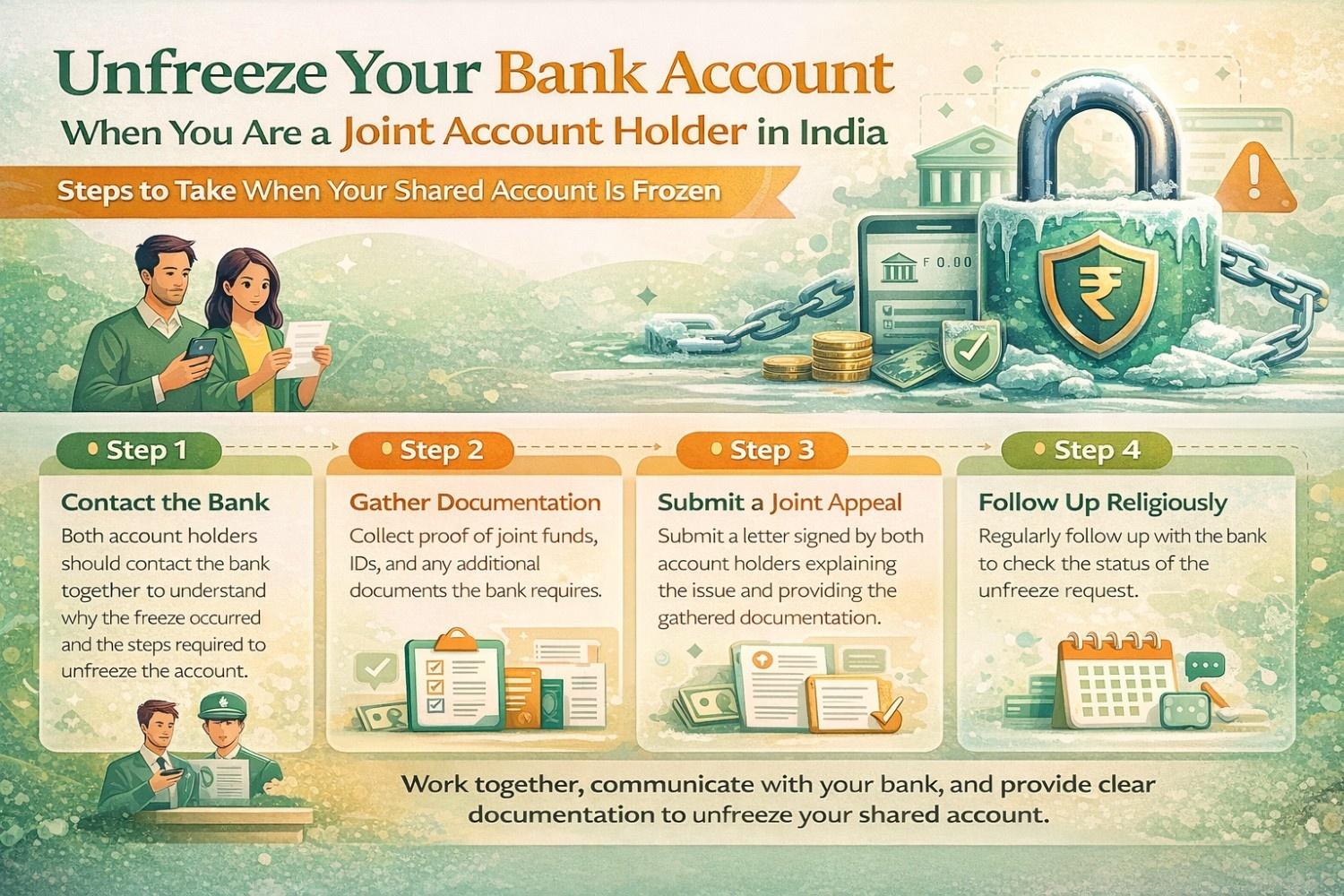
A Joint Account Freeze Can Punish an Innocent Co-Holder
Joint bank accounts are extremely common in India — spouses maintain joint accounts for household expenses, business partners maintain joint operating accounts, parents and children maintain joint savings accounts, and elderly individuals maintain joint accounts with trusted relatives for convenience. What most joint account holders do not think about until it is too late is the legal vulnerability that comes with a joint account — the risk that one account holder's legal problems can result in the entire joint account being frozen, leaving the innocent co-holder completely locked out of their own funds.
This is not a theoretical risk. It happens regularly in India and it happens across every type of joint account freeze scenario — court orders, tax attachments, cybercrime holds, and ED provisional attachments can all result in a joint account freeze that affects both holders equally regardless of who actually owns the funds in the account.
If you are an innocent joint account holder whose account has been frozen because of your co-holder's legal problems, this guide explains exactly what has happened and the complete legal process to unfreeze your bank account and protect your rightful share of the funds.
How Joint Accounts Get Frozen in India
Joint account freezes arise from the same range of authorities as individual account freezes — but with an additional layer of complexity created by the joint nature of the account:
Court Order Against One Co-Holder When a court issues an attachment order or garnishee order against one of the joint account holders, the order is typically directed at all accounts held in that person's name — including joint accounts. The bank freezes the entire joint account even though only one holder is the subject of the court order.
Income Tax or GST Attachment Against One Co-Holder Income tax and GST attachment orders are directed at the taxpayer's accounts — but where a joint account exists, the entire account is attached even though the co-holder has no connection to the outstanding tax demand. The innocent co-holder's funds are locked alongside the defaulting co-holder's funds with no distinction.
Cybercrime Investigation Freeze When a cybercrime complaint traces stolen funds to a joint account, both account holders are affected by the resulting freeze — even if only one was involved in the transaction that triggered the investigation.
ED PMLA Provisional Attachment An Enforcement Directorate provisional attachment directed at one joint account holder freezes the entire account — meaning the innocent co-holder cannot access even their own documented contributions to the account.
Legal Steps to Unfreeze Your Bank Account as an Innocent Joint Holder
Step 1: Establish Your Innocent Co-Holder Status Immediately
Your lawyer files an urgent representation before the authority that ordered the freeze — whether a court, tax department, cybercrime cell, or ED — establishing clearly that you are the innocent co-holder with no connection to the legal proceedings that gave rise to the freeze. This representation must be supported by documentation showing the source of your specific contributions to the joint account — salary credits, business income, inheritance, or other clearly documented personal funds.
Step 2: Apply for Partial Release of Your Share
In most legal frameworks governing joint account freezes in India, the innocent co-holder has the right to apply for partial release of their documented share of the joint account funds — even while the freeze over the other co-holder's share remains in force. Your lawyer files a formal partial release application before the issuing authority with complete documentation of your individual contribution to the frozen account.
Key documents needed to establish your share:
- Bank statements showing the source of your specific deposits into the joint account
- Salary slips, business account statements, or inheritance documents corresponding to your deposits
- Any written agreement between the joint account holders regarding the ownership of funds in the account
- Tax returns showing that the funds you deposited were declared as your individual income
Step 3: Approach the Court or High Court for Severance of the Joint Account
If the issuing authority does not release your share within a reasonable time, your lawyer files an application before the issuing court or a writ petition before the High Court seeking a direction that the joint account be operationally severed — allowing your share to be transferred to a new individual account while the freeze over the other co-holder's share remains in force pending resolution of their legal matter.
The Lesson Every Joint Account Holder Must Learn
The most important financial protection available to joint account holders in India is maintaining clear, documented records of every individual contribution made to the joint account. Without this documentation it becomes extremely difficult to establish your share and obtain partial release in the event of a freeze caused by the other co-holder's legal problems.
If you are an innocent joint account holder whose account has been frozen today — engage the right lawyer immediately. Your funds can be protected and your access can be restored, but only if the correct legal steps are taken without any further delay.

 English
 Arabic
 French
 Spanish
 Portuguese
 Deutsch
 Turkish
 Dutch
Dutch
 Italiano
 Russian
 Romaian
 Portuguese (Brazil)
 Greek
Greek