
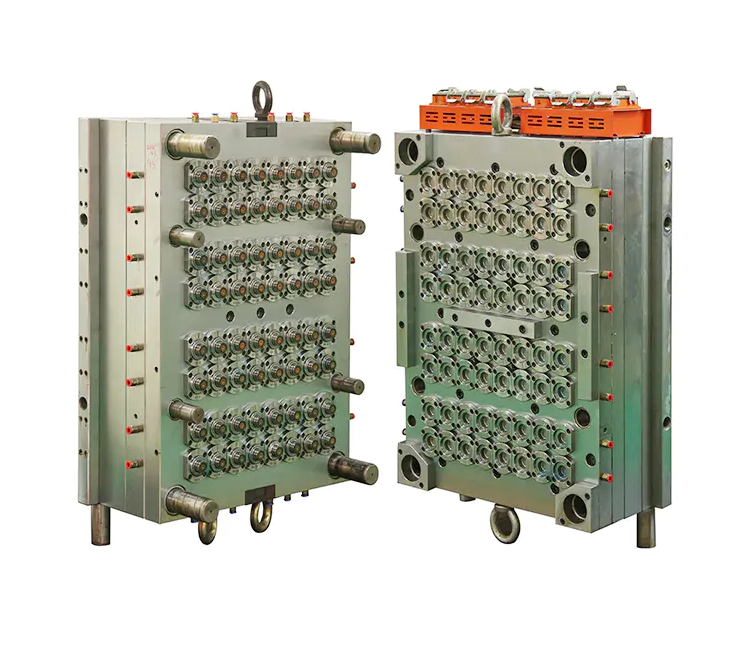
The Preform mold serves as the foundation for producing consistent plastic preforms used in bottles and containers. Each mold is designed to shape molten polymer accurately, allowing the final product to achieve uniform dimensions and mechanical properties. Attention to mold design, material selection, and cooling is essential for reliable preform production.
A key role of the Preform mold is to control the shape and thickness distribution of preforms. Injection molding ensures that polymer fills the cavity completely and solidifies uniformly. Uneven cooling or design flaws can lead to defects such as thin spots, warping, or irregular weight. Proper mold engineering minimizes these issues and supports stable production.
The materials used in Preform mold fabrication are selected for durability and heat resistance. Mold steels and treated alloys withstand repeated thermal cycling without deformation. Surface polishing and coatings reduce friction, allowing smooth polymer flow and easier preform ejection. These features reduce production interruptions and help maintain preform quality across extended runs.
Preform molds are designed for versatility. They can produce preforms of varying sizes and neck types without major modifications. Modular components, such as interchangeable cavities, allow manufacturers to adapt to different product requirements efficiently. This flexibility is important for facilities producing multiple bottle formats on the same equipment.
Cooling systems are integrated within Preform molds to remove heat rapidly from the injected polymer. Water or oil channels provide controlled cooling that maintains preform dimensions and reduces cycle time. Uniform cooling is critical for avoiding internal stresses that may affect later blow molding operations. Efficient thermal management supports both production speed and product quality.
Design considerations extend to cavity geometry and runner systems. Proper flow paths reduce pressure loss, ensure uniform filling, and prevent defects. Simulation tools allow engineers to predict material behavior during injection, enabling improvements before mold fabrication. Accurate design reduces trial-and-error during production and supports consistent outcomes.
Routine maintenance enhances the operational life of Preform molds. Regular inspections, cleaning, and polishing prevent wear accumulation and ensure smooth operation. Addressing minor damage early avoids interruptions and maintains dimensional accuracy. Ongoing care improves both productivity and cost-effectiveness in preform manufacturing.
Preform molds are central to plastic bottle production. They provide precise shaping, consistent wall thickness, and flexibility to accommodate different container designs. Improvements in mold materials, construction techniques, and cooling methods continue to enhance performance. The Preform mold remains a reliable and practical tool in producing uniform preforms for a wide range of applications.

 English
 Magyar
 Arabic
 Spanish
 Portuguese
 Deutsch
 Turkish
 Dutch
Dutch
 Italiano
 Russian
 Romaian
 Portuguese (Brazil)
 Greek
Greek