
Executive Summary
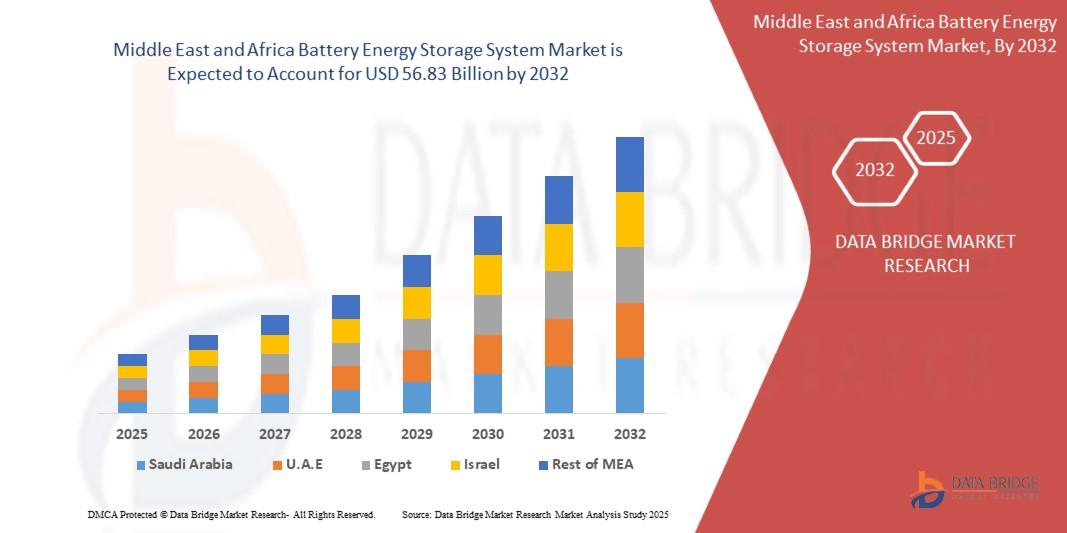
The Middle East and Africa Battery Energy Storage System Market is witnessing an aggressive growth phase, primarily driven by large-scale renewable energy integration and national diversification strategies such as Saudi Vision 2030 and UAE Energy Strategy 2050. As the region pivots away from fossil fuel dependency, battery energy storage systems (BESS) have become critical for grid stabilization and managing the intermittency of solar and wind power. The market is characterized by massive utility-scale projects and a rapidly developing supply chain supported by significant government investments.
Market Overview
The Middle East and Africa Battery Energy Storage System Market involves the deployment of advanced electrochemical storage solutions to capture electrical energy for later use. This market is a cornerstone of the region's energy transition, enabling the "firming" of renewable energy sources. The ecosystem is shifting from small-scale pilot programs to multi-gigawatt pipelines, particularly in the Gulf Cooperation Council (GCC) countries. Key enablers include falling lithium-ion battery costs, favorable trade relations with major manufacturing hubs like China, and a growing need to modernize aging grid infrastructures in Sub-Saharan Africa.
Market Size & Forecast
The Middle East and Africa Battery Energy Storage System Market was valued at approximately USD 16.35 Billion in 2024 and is projected to reach USD 56.83 Billion by 2032. The market is expected to grow at a CAGR of 16.95% during the forecast period of 2025 to 2032. This rapid expansion is fueled by the region's unique position as a high-solar-irradiation zone, making BESS economically viable for 24/7 clean energy delivery.
Market Segmentation
- By Battery Type: Lithium-Ion Batteries, Lead-Acid Batteries, Flow Batteries, and Sodium-Sulfur Batteries. Lithium-ion batteries dominate the market with over 90% share due to high energy density and declining costs.
- By Connection Type: On-Grid and Off-Grid. The On-Grid segment accounts for the largest share as utilities integrate storage into national power networks.
- By Application: Utility-Scale, Commercial & Industrial (C&I), and Residential. Utility-Scale storage is the primary driver, accounting for over 65% of the total market value.
- By Ownership: Utility-Owned, Customer-Owned, and Third-Party Owned.
Regional Insights
Saudi Arabia is the leading market in the region, holding a significant share with a massive project pipeline, including the Neom 1.3 GWh project. The United Arab Emirates (UAE) follows closely, with the Mohammed bin Rashid Al Maktoum Solar Park incorporating significant storage capacity. In South Africa, the market is driven by the need for grid reliability and "load shedding" mitigation, while Egypt is emerging as a hub for renewable-plus-storage hybrid projects. The GCC countries benefit from a lack of import tariffs on battery components, making them some of the most cost-competitive markets globally.
Competitive Landscape
The Middle East and Africa Battery Energy Storage System Market is highly competitive, with global technology giants competing alongside regional energy conglomerates. Strategic partnerships and vertical integration are common as players look to secure supply chains.
Top Market Players:
- Tesla, Inc. (U.S.)
- BYD Company Ltd. (China)
- ABB (Switzerland)
- Samsung SDI Co., Ltd. (South Korea)
- LG Energy Solution (South Korea)
- General Electric (U.S.)
- ACWA Power (Saudi Arabia)
- Masdar (UAE)
- Huawei Digital Power (China)
- NGK INSULATORS, LTD. (Japan)
Trends & Opportunities
- Gigafactory Announcements: Increasing interest in localized manufacturing to reduce logistics costs and meet "local content" requirements in government tenders.
- Long-Duration Storage: Growing exploration of flow batteries and thermal storage for 8+ hour discharge cycles to support base-load solar power.
- Digitalization & AI: Use of AI-driven Battery Management Systems (BMS) to optimize charging cycles and participate in frequency regulation markets.
Challenges & Barriers
- Harsh Climatic Conditions: Extreme heat in the Middle East requires advanced thermal management and cooling systems, increasing auxiliary power consumption.
- High Upfront Capital: Despite falling costs, the initial investment remains a barrier for smaller African economies and private C&I players.
- Regulatory Gaps: Inconsistent policy frameworks regarding grid-access for storage and the lack of standardized "storage-as-a-service" business models.
Conclusion
The Middle East and Africa Battery Energy Storage System Market is positioned to be one of the fastest-growing globally as it transitions from a niche technology to a core utility infrastructure. While Saudi Arabia and the UAE will continue to lead in terms of capacity, the expansion of decentralized storage in Sub-Saharan Africa offers long-term growth potential. Success for market participants will depend on their ability to adapt technology for high-temperature environments and navigate the evolving regulatory landscapes of the region.
Browse Trending Report:
Global Fertilizing and Plant Protection Equipment Market
Global Fiberglass Fabric Market
Global Fibrinogen Testing Market
Global Field Crop Seeds Market
Global Film Formers Market
Global Finance Cloud Market
Global Firewall as a Service (FWAAS) Market
Global Fitness Trackers Market
Global Flame Retardant Thermoplastics Market
Global Flexible Paper Market
Global Flexible and Semi Rigid Ureteroscopy Market
Global Floating Solar Panel Market
Global Food and Beverages Metal Cans Market
Global Food Anti Caking Agents Market
Global Food Cans Market
Contact Us:
Data Bridge Market Research
US: +1 614 591 3140
UK: +44 845 154 9652
APAC: +653 1251 975
Email: [email protected]

 English
 Magyar
 Arabic
 Spanish
 Portuguese
 Deutsch
 Turkish
 Dutch
Dutch
 Italiano
 Russian
 Romaian
 Portuguese (Brazil)
 Greek
Greek