
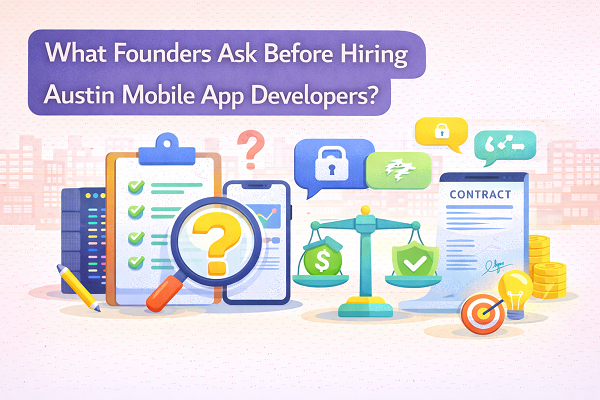
The first conversation is usually polite. Timelines. Platforms. Ballpark numbers. The second conversation is more revealing. Founders start asking questions that sound less like hiring and more like risk assessment. What happens after launch? Who owns decisions when something breaks? How hard will it be to change this in a year?
In Austin’s competitive startup environment, founders have learned these questions the hard way. Many have already rebuilt one app. Others have inherited systems they did not design. By 2026, hiring mobile developers is no longer about who can ship fastest. It is about who can live with the product when conditions change.
Founders no longer start with “How fast can you build this?”
Speed still matters, but it is no longer the opening move.
Austin founders now start with questions about structure and accountability. They want to understand how a team thinks before they care how fast it types. This shift reflects experience. According to CB Insights, a large share of startup failures still trace back to execution problems rather than idea quality. Founders are responding by probing execution maturity early.
The tone of early conversations has changed from excitement to clarity.
“What assumptions are you making about our product?”
This question separates order-takers from partners.
Founders want to know whether developers will blindly follow requirements or challenge them. Assumptions about scale, usage patterns, data sensitivity, and future change shape architecture long before features do.
According to McKinsey, teams that surface and test assumptions early reduce rework significantly over the product lifecycle. Austin founders increasingly expect developers to articulate assumptions openly rather than hide them behind estimates.
Silence here is a red flag.
“What breaks first if we grow faster than expected?”
Growth is no longer hypothetical in Austin. It happens quickly when it happens at all.
Founders want to know how systems fail under stress. Do they degrade gracefully? Do they fall over? Do they become expensive to operate? These questions reflect an understanding that success creates pressure, not comfort.
Developers who can describe failure modes calmly tend to inspire more confidence than those who promise perfection.
“How do you handle post-launch ownership?”
This question comes up early now, not at the end.
Founders have learned that launch is not the finish line. It is the moment responsibility becomes real. Monitoring, on-call support, bug triage, and updates determine whether an app remains stable or becomes a distraction.
According to Gartner, a significant portion of application cost accrues after launch, not during initial development. Austin founders now budget and plan accordingly, and they expect developers to do the same.
Vague answers here often end conversations.
“How do you plan for change without rewriting everything?”
Every founder expects change. The difference is whether the system can absorb it.
Austin founders increasingly ask how features can evolve without destabilizing the core. They want to hear about modular design, clear boundaries, and decision points that preserve flexibility.
Martin Fowler, a respected software engineer and author, has long argued that the dominant cost of software is change, not creation. Founders who have felt that cost firsthand now listen closely to how developers talk about evolution.
“What happens if we stop working together?”
This is one of the most telling questions.
Founders are not being adversarial. They are being practical. They want to understand documentation standards, handover processes, and dependency risk. An app that only one team can maintain is a liability.
Teams that answer this question openly, without defensiveness, tend to be trusted more. Confidence shows in willingness to make oneself replaceable.
“How do you balance quality with budget reality?”
Austin founders are not naïve about cost. They know trade-offs exist.
What they want is honesty. Where can quality be safely reduced? Where can it not? What saves money now but costs more later? These conversations require experience, not scripts.
According to industry research cited by Forrester, organizations that make explicit trade-offs early experience fewer cost overruns and higher satisfaction with vendors.
Founders prefer clarity over optimism.
“Who makes the hard calls when priorities conflict?”
This question reveals governance expectations.
Founders want to know how decisions are made under pressure. When product wants speed and engineering wants stability, who decides? How are disagreements resolved? What principles guide those choices?
Teams that avoid this question often struggle later. Teams that answer it clearly reduce friction before it appears.
“How do you think about security and risk?”
Security is no longer a specialist topic. Founders ask about it early.
They want to know how access is controlled, how data is handled, and how incidents are detected. Not because they expect perfection, but because they want to see awareness.
According to IBM’s data breach research, application-layer weaknesses remain a common source of incidents. Austin founders, especially in regulated or data-sensitive industries, are factoring this into hiring decisions earlier than ever.
“What does success look like six months after launch?”
This question reframes the entire conversation.
Founders want developers who think beyond delivery. Who talk about stability, iteration speed, user feedback, and operational calm. The answer reveals whether a team sees its job as shipping or stewardship.
This mindset is increasingly decisive when hiring for mobile app development Austin projects, where long-term ownership matters as much as initial delivery.
Expert perspective that mirrors founder behavior
Diego Lo Giudice, VP and Principal Analyst at Forrester, has noted that successful digital products emerge from shared accountability rather than contractual scope alone. His observation aligns closely with how Austin founders now evaluate partners.
From a leadership angle, investor commentary increasingly emphasizes execution discipline over feature ambition. Founders are internalizing that message.
Closing thought
The questions Austin founders ask today are quieter than they used to be. Less about hype. More about consequences.
They are not looking for developers who promise everything. They are looking for teams who understand what happens after the promise. In a market where speed is common but durability is rare, those questions are no longer cautious. They are necessary.

 English
 Magyar
 Arabic
 Spanish
 Portuguese
 Deutsch
 Turkish
 Dutch
Dutch
 Italiano
 Russian
 Romaian
 Portuguese (Brazil)
 Greek
Greek