
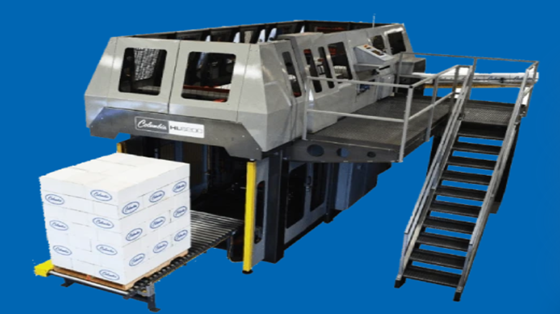
In the high-speed environment of modern manufacturing, a high level palletizer is often the heartbeat of the end-of-line process. By receiving products at an elevated infeed and stacking them systematically, these machines ensure that production keeps moving without bottlenecks. However, because they handle heavy loads at rapid cycles, wear and tear are inevitable.
To protect your investment and ensure the longevity of your equipment, a proactive maintenance strategy is essential. Whether you are operating a standard unit or specialized Columbia Machine India Palletizers, following these key maintenance tips will keep your system running at peak performance.
1. Prioritize a Proactive Lubrication Schedule
Lubrication is the single most important factor in extending the life of moving parts. A high level infeed palletizer relies on a complex network of chains, bearings, and gears to lift and sweep layers.
The Routine: Follow the manufacturer’s specific recommendations for lubricant types. Over-lubricating can attract dust and debris, while under-lubricating leads to friction and catastrophic component failure.
Focus Areas: Pay close attention to the hoist system, slide plates, and row-forming area, as these undergo the most frequent movement.
2. Conduct Daily and Weekly Visual Inspections
Don't wait for a sensor alarm to tell you something is wrong. Small issues, like a loose bolt or a fraying belt, can escalate into major breakdowns if ignored.
Daily: Check for unusual noises, vibrations, or air leaks in pneumatic lines. Ensure safety guards and light curtains are functional.
Weekly: Inspect the condition of the infeed conveyors and the "sweep arm" mechanisms. Clean any accumulated dust from photo eyes and sensors to prevent false readings and line stops.
3. Calibrate Sensors and Align Conveyors
The precision of a high level palletizer depends on accurate data from its sensors. Over time, vibration can cause sensors to drift or conveyors to misalign.
Sensor Care: Clean the lenses of all photo eyes and lasers regularly. Calibrate them to ensure they are detecting product dimensions and positions correctly.
Alignment: Check the tension and alignment of the infeed belts. Misaligned belts can cause cases to twist, leading to "rhombus-shaped" stacks or jams in the row-forming section.
4. Maintain the Pneumatic and Hydraulic Systems
Many high-level systems use pneumatics for gripping and hydraulics for heavy lifting.
Air Quality: Ensure that your air filters are clean and that the lubrication-oilers (if applicable) are topped up. Moisture in the air lines can corrode internal valves.
Hydraulic Fluid: For machines with hydraulic lifts, check the oil quality and levels monthly. Contaminated oil can reduce lifting power and damage expensive pumps.
5. Software Updates and HMI Backups
A palletizer is only as smart as its programming. Modern Columbia Machine India Palletizers use sophisticated software to manage complex pallet patterns.
Updates: Keep your PLC firmware and HMI software up to date to benefit from performance patches and new safety features.
Backups: Regularly back up your pallet patterns and system configurations. In the event of a power surge or hardware failure, having a recent backup can reduce recovery time from days to minutes.
6. Spare Parts Management
When a critical component fails, every minute of downtime is a loss in revenue. Waiting for an international shipment for a specialized motor or sensor is a risk you shouldn't take.
The Essential Kit: Maintain an on-site inventory of high-wear parts, including belts, sensors, fuses, and cylinder seals.
Genuine Parts: Always use original equipment manufacturer (OEM) parts. Non-genuine parts may be cheaper initially but can lead to compatibility issues and voided warranties.
7. Invest in Continuous Operator Training
The best maintenance tool is a well-trained operator. Many mechanical failures are actually the result of human error or improper settings.
The Benefit: Operators who understand the "how and why" of the machine are more likely to notice early warning signs of wear.
Ongoing Education: Provide refresher training sessions annually to cover new safety protocols and efficient pattern-changing techniques.
8. Monitor Pallet Quality
Sometimes the machine isn't the problem—it's the pallet. Poor-quality wooden pallets with loose boards or protruding nails can jam the dispenser or cause the stack to tilt.
Inspection: Ensure that only pallets matching the machine's specifications are loaded into the magazine. Using consistent, high-quality pallets reduces the mechanical strain on the palletizer’s handling system.
Conclusion: Consistency is the Key to ROI
A high level palletizer represents a significant capital investment, and its performance directly impacts your bottom line. By shifting from a "fix-it-when-it-breaks" mentality to a disciplined, preventative approach, you can significantly reduce the Total Cost of Ownership (TCO). Whether it’s the simple act of wiping down a sensor or the technical task of calibrating a hoist, every maintenance action is a step toward a more reliable, efficient, and profitable production line.

 English
 Arabic
 French
 Spanish
 Portuguese
 Deutsch
 Turkish
 Dutch
Dutch
 Italiano
 Russian
 Romaian
 Portuguese (Brazil)
 Greek
Greek