
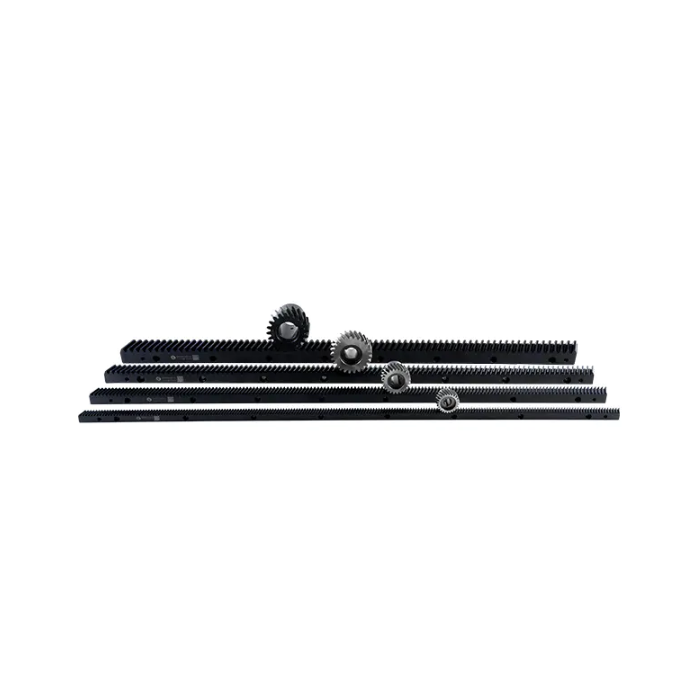
The Symphony of Parallelism: Engineering Synchronized Motion
In high-performance automation, the most demanding applications often rely on gantry systems—where a crossbeam or platform is driven by two parallel linear axes that must move in perfect unison. Any loss of synchronization results in yaw (rotation), binding, accelerated wear, and catastrophic loss of precision. For a helical ground rack manufacturer, the ultimate challenge transcends producing two excellent individual racks; it is to produce them as a perfectly matched, synchronized pair that functions as a single kinematic entity. This demands an unprecedented level of process control, from material sourcing to final validation, where the concept of "tolerance" is applied to the relationship between components, not just to each one in isolation.
Foundational Synchronization: Master-Referenced Manufacturing from a Unified Datum
True synchronization is engineered from the very first machining step. Leading manufacturers employ a "master-reference" or "family-of-parts" methodology. This means that both racks for a synchronized pair are manufactured in the same production cycle, on the same precision grinding machine, and, most critically, referenced from the same physical or digital master datum.
The process begins with the precision grinding of the mounting reference surfaces (the back and side alignment faces) on both raw rack blanks. These surfaces are ground not just to be flat and perpendicular, but to be functionally identical between the two pieces. The blanks are then secured in the grinding machine using these common reference surfaces. The CNC grinding program, generated from a single, perfected digital model, is then executed on both racks sequentially without altering the machine setup. This ensures that the critical helix angle, tooth profile, and pitch are replicated with near-perfect identity, as any minute systemic error in the machine's geometry or program will be common to both racks and thus cancel out in the paired system.
Metrological Verification of Paired Kinematics
Verifying synchronization requires moving beyond the inspection of individual racks to measuring their functional relationship. After manufacturing, the racks undergo paired metrology. They are placed on a massive, temperature-controlled surface plate in their final installation orientation. Using a high-precision laser interferometer system or an ultra-accurate linear scale as a master reference, a specialized measuring probe travels along both racks simultaneously.
The system does not merely measure each rack's individual cumulative pitch error; it measures the differential positional error between the two racks at every point along their length. The output is a synchronization error map, graphically showing if one rack "leads" or "lags" the other by even a few microns over the travel. This data is the ultimate proof of performance. Furthermore, the manufacturer will often mount the racks on a surrogate, granite reference beam to measure the system's "walking error" – the parasitic yaw motion that would be induced in a real gantry—providing a direct prediction of installed performance.
System-Level Delivery: Matched Components and Prescriptive Installation
The manufacturer's responsibility extends to delivering a synchronized system kit. This includes not only the paired racks, certified with their synchronization error report, but also the precisely matched pinions (with controlled tooth thickness and lead), and often custom alignment tools or shim sets. They provide a prescriptive installation protocol that details the exact sequence for mounting the reference surfaces to the machine base, the torque sequence for fasteners, and the final laser alignment verification procedure to be performed on-site. By controlling every element—the racks, the pinions, and the alignment methodology—the manufacturer transfers a guaranteed kinematic performance from their factory floor to the customer's machine. They solve the system-level problem of synchronization at the component level, transforming one of motion control's most complex integration challenges into a predictable, plug-and-play reality.
For a helical ground rack manufacturer, this capability represents the pinnacle of their craft. It demonstrates a shift from being a producer of precision parts to being the architect of guaranteed motion integrity. In the world of high-stakes manufacturing, semiconductor lithography, or aerospace assembly, this guaranteed synchronization is not a luxury; it is the fundamental requirement that enables the next generation of technological precision.

 English
 Magyar
 Arabic
 French
 Spanish
 Portuguese
 Deutsch
 Turkish
 Dutch
Dutch
 Italiano
 Russian
 Portuguese (Brazil)
 Greek
Greek