
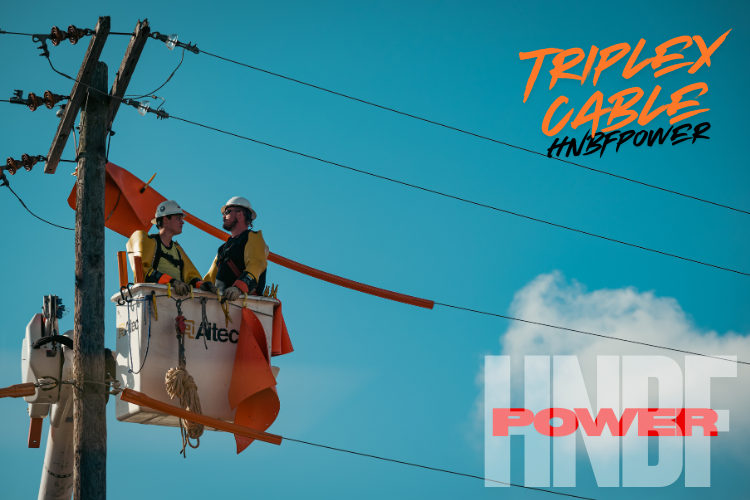
In the evolving world of power transmission and distribution, ensuring efficient and safe electricity delivery is paramount. One of the most reliable solutions for low-voltage overhead distribution is the triplex cable. Designed for overhead lines, triplex cables are widely adopted by utilities, contractors, and industrial projects worldwide due to their durability, compact design, and ease of installation. As a global manufacturer of overhead conductors and power cables, HNBF Power provides high-quality triplex cables that meet international standards and deliver consistent performance across varied environmental conditions.
In this guide, we will explain the features, applications, and advantages of triplex cables to help engineers and procurement buyers make informed decisions.
What is a Triplex Cable?
A triplex cable is a type of low-voltage, overhead service cable typically used for power distribution in residential, commercial, and light industrial networks. It consists of three insulated conductors twisted together two phase conductors and one neutral conductor forming a compact, self-supporting cable. This design allows for efficient energy transmission while minimizing installation complexity.
Triplex cables are usually made from aluminum or aluminum alloy conductors, which offer excellent conductivity, lightweight properties, and corrosion resistance. The insulation is generally made from cross-linked polyethylene (XLPE) or similar high-quality polymers, providing high electrical strength and environmental protection.
Key Features of Triplex Cables
1. Compact and Lightweight Design
Triplex cables combine multiple conductors into a single unit, reducing clutter on utility poles and simplifying installation. The lightweight nature of aluminum conductors also makes handling and stringing easier, particularly for long spans.
2. Corrosion Resistance and Durability
With aluminum conductors and robust insulation, triplex cables resist corrosion, UV exposure, and moisture. This ensures long-term performance even in harsh outdoor environments.
3. Excellent Electrical Performance
Triplex cables maintain stable voltage levels and minimal power loss, making them ideal for distributing electricity efficiently to homes, commercial buildings, and small industries.
4. Easy Installation and Maintenance
The twisted, self-supporting structure eliminates the need for separate neutral support wires, simplifying overhead line construction and reducing maintenance costs.
Applications of Triplex Cables
Triplex cables are versatile and suitable for various low-voltage overhead applications, including:
-
Residential Power Distribution: Reliable service connections from poles to homes.
-
Commercial Buildings: Efficient overhead wiring for shops, offices, and complexes.
-
Industrial Facilities: Secondary distribution in small-scale industrial plants.
-
Rural Electrification Projects: Safe and cost-effective power delivery in remote areas.
By using triplex cables, utility providers can ensure secure and efficient energy distribution while keeping installation costs low.
Advantages of Choosing Triplex Cables from HNBF Power
HNBF Power has decades of experience in manufacturing premium-quality power conductors and cables. Choosing our triplex cables offers several advantages:
-
Global Quality Standards: All HNBF Power triplex cables adhere to ISO, IEC, and relevant national standards.
-
Customizable Solutions: We provide tailor-made conductor sizes and insulation options to meet specific project requirements.
-
Enhanced Reliability: Our cables are tested for tensile strength, electrical performance, and environmental resistance to ensure long-lasting operation.
-
Expert Technical Support: Our team assists engineers and procurement buyers in selecting the right cable for each application.
Installation Considerations
While triplex cables simplify overhead distribution, proper installation is critical to maximize performance and safety:
-
Ensure correct pole height and spacing to prevent sagging.
-
Use appropriate hardware for secure clamping and termination.
-
Avoid excessive bending to maintain insulation integrity.
-
Follow local electrical codes and industry standards.
By following these guidelines, triplex cables can provide decades of reliable service with minimal maintenance.
Frequently Asked Questions (FAQs)
Q1: What is the difference between triplex cable and duplex cable?
A: Triplex cables have three conductors (two phases and one neutral), whereas duplex cables have two conductors. Triplex cables are primarily used for overhead low-voltage distribution.
Q2: Can triplex cables be used for underground installations?
A: Triplex cables are designed for overhead applications. For underground installations, specialized cables like XLPE insulated underground cables are recommended.
Q3: What materials are used in triplex cables?
A: Triplex cables usually use aluminum or aluminum alloy conductors with XLPE insulation, offering high conductivity, corrosion resistance, and durability.
Q4: How long can a triplex cable last?
A: With proper installation and environmental protection, triplex cables can last 20–30 years or more.
Q5: Can HNBF Power provide customized triplex cable solutions?
A: Yes, HNBF Power offers fully customizable triplex cables to match specific project voltage, conductor size, and insulation requirements.
Conclusion
Triplex cables are a practical and reliable choice for modern low-voltage overhead power distribution. Their compact design, durability, and excellent electrical performance make them ideal for residential, commercial, and industrial applications.
As a trusted global manufacturer, HNBF Power delivers high-quality triplex cables that meet international standards and provide reliable service in diverse conditions.
For engineers, procurement buyers, and utilities looking for customized, high-performance triplex cables, contact HNBF Power today and discover tailored solutions that meet your exact project requirements.

 English
 Arabic
 French
 Spanish
 Portuguese
 Deutsch
 Turkish
 Dutch
Dutch
 Italiano
 Russian
 Romaian
 Portuguese (Brazil)
 Greek
Greek