
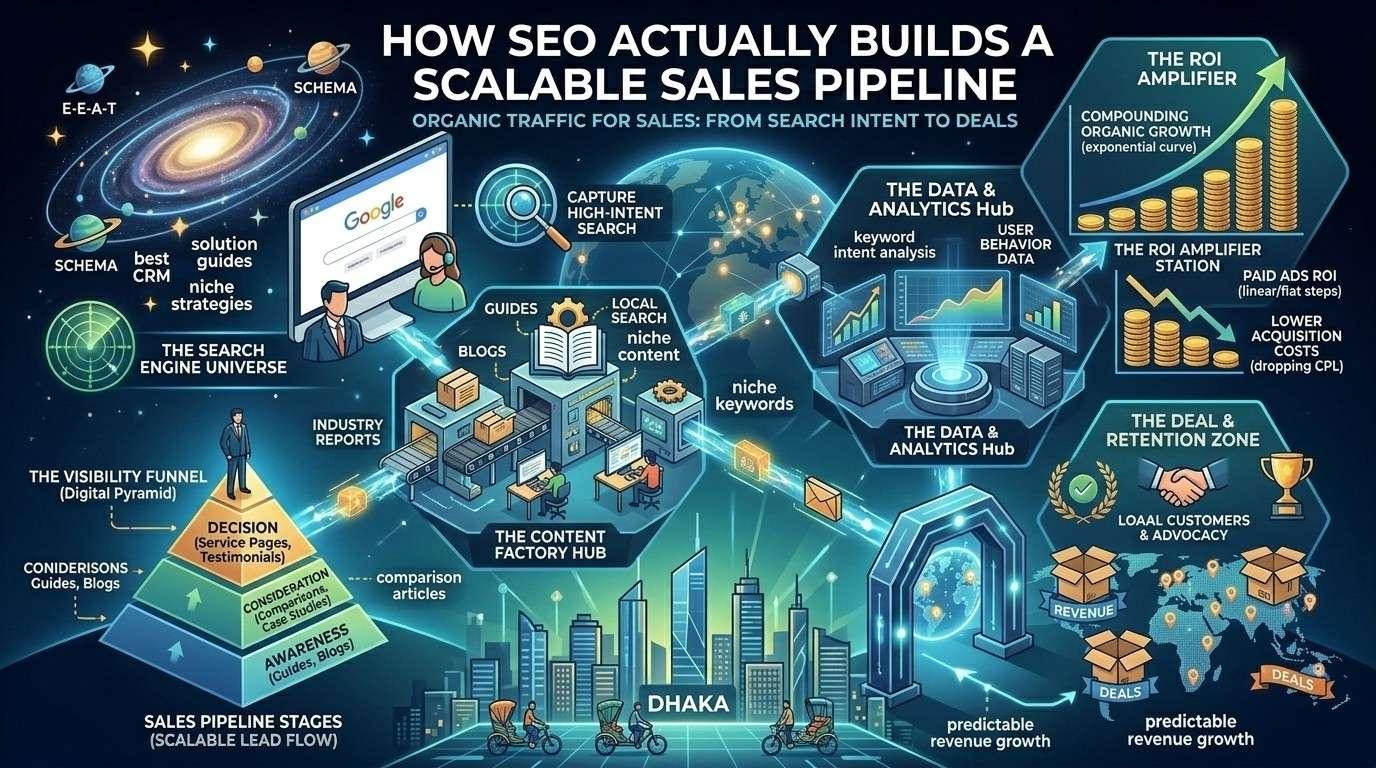
For many business owners, Search Engine Optimization (SEO) is often misunderstood as a vanity project—a way to see your name at the top of Google or a race to rank for high-volume keywords. In reality, SEO is the most powerful engine for building a scalable sales pipeline available in the digital age.
While traditional sales methods like cold outreach or paid advertising are effective, they are inherently "linear." If you want more leads from cold calling, you must hire more callers. If you want more leads from ads, you must increase your daily budget. SEO, however, is exponential. It is a system that grows in authority and output without requiring a proportional increase in costs.
What Is a Scalable Sales Pipeline?
A sales pipeline is the visual representation of your sales process, from the moment a lead discovers your brand to the moment they sign a contract. A scalable pipeline is one that can handle a significant increase in lead volume while maintaining—or even improving—profit margins.
The pillars of a scalable pipeline include:
-
Predictability: Knowing where your leads are coming from each month.
-
Efficiency: Reducing the manual labor required to find new prospects.
-
Lower Acquisition Costs: Ensuring that as you grow, the cost of acquiring one customer stays stable or decreases.
Why Traditional Lead Generation Struggles to Scale
Traditional lead generation often hits a "ceiling." Cold outreach, while valuable, is time-consuming and increasingly blocked by spam filters and "gatekeepers." Paid advertising (PPC) is a "pay-to-play" model; the moment you stop spending, the leads disappear.
Furthermore, customer acquisition costs (CAC) on platforms like Google Ads and Meta have risen steadily over the last few years. If your sales pipeline relies solely on paid ads, your margins will eventually be squeezed by rising auction prices. This is why businesses are turning to inbound marketing through SEO to build a more resilient foundation.
How SEO Drives High-Intent Traffic
The magic of search engines is that they connect you with people who are actively looking for you. This is the difference between "push" marketing (interrupting someone's day with an ad) and "pull" marketing (being the answer to their specific problem).
SEO targets "Buying-Stage" Queries:
-
Informational Intent: "How to improve warehouse efficiency?"
-
Commercial Intent: "Best warehouse management software for small business."
-
Transactional Intent: "Warehouse SEO agency for hire."
When you rank for these terms, the traffic hitting your site isn't just "browsing"—they are high-intent prospects who are already halfway through the decision-making process.
SEO as a Continuous Lead Generation Engine
Think of SEO as a 24/7 salesperson who never sleeps, never takes a vacation, and never asks for a commission.
-
Service Pages: These act as your digital storefront, converting high-intent visitors into direct inquiries.
-
Educational Blog Posts: These capture visitors at the top of the funnel, establishing your brand as a trusted authority before they even know they need your specific product.
-
Evergreen Content: A well-optimized guide written three years ago can still generate 50 leads a month today without any additional work. This is the definition of long-term SEO growth.
Building Content for Every Stage of the Funnel
To build a truly SEO-driven sales pipeline, you must map your content to the buyer’s journey.
1. Top of Funnel (Awareness)
Focus on educational guides and industry insights.
Goal: Capture the largest possible audience by solving their initial problems.
2. Middle of Funnel (Consideration)
Focus on comparison articles, "Best of" lists, and strategy guides.
Goal: Position your solution as the superior choice among alternatives.
3. Bottom of Funnel (Decision)
Focus on case studies, pricing pages, and service-specific landing pages.
Goal: Remove the final friction points and drive the conversion.
Compounding Growth: Why SEO Improves Over Time
Paid ads are like a light switch; SEO is like a snowball. As you publish more content, your "Domain Authority" grows. As you earn backlinks from other sites, your rankings for all pages improve.
In the first six months, you might pay $\$100$ per lead through SEO effort. By year two, that same effort might result in a cost per lead of $\$10$. This compounding effect is why organic traffic for sales is the preferred strategy for high-growth SaaS and B2B companies.
SEO Data Helps Optimize the Sales Funnel
SEO isn't just about traffic; it’s about intelligence. The data provided by search queries tells you exactly what your customers are worried about, what features they want, and what objections they have.
By analyzing user behavior on your site, you can refine your sales messaging and improve your conversion rate optimization (CRO), ensuring that your pipeline isn't just "full," but "efficient."
SEO vs. Paid Ads for Sales Pipeline Growth
| Feature | Paid Ads (PPC) | SEO (Organic) |
| Speed | Immediate results. | Takes 3–6 months. |
| Sustainability | Ends when budget ends. | Leads keep coming indefinitely. |
| Trust | Users often skip ads. | Organic results are highly trusted. |
| Cost | Linear (More leads = more cost). | Compounding (Cost per lead drops). |
The most successful companies use SEO as their foundation and use paid ads to "supplement" certain campaigns or test new product ideas.
Conclusion
SEO is far more than a technical checklist; it is a scalable marketing strategy that builds a predictable, high-intent sales pipeline. By investing in organic search today, you are creating an asset that will continue to pay dividends for years to reach.
If you want to stop the "feast or famine" cycle of traditional sales, it’s time to start building your authority on the search results page.
FAQ
1. How does SEO generate leads for a sales pipeline?
SEO captures prospects who are actively searching for solutions. By providing the best answer to their query, you drive them to your site and convert them through calls-to-action.
2. Why is SEO considered a scalable marketing strategy?
Unlike ads, where you pay for every click, SEO content works 24/7. Once a page ranks, it continues to attract leads without additional ad spend.
3. How long does it take for SEO to build a sales pipeline?
You will typically see early signs of growth in 3–6 months, with a fully "scalable" engine taking between 6 and 12 months to reach peak momentum.
4. Is SEO better than paid advertising for lead generation?
SEO offers a better long-term ROI and higher lead quality, but paid ads are superior for immediate speed. A healthy pipeline usually uses both.
5. What type of content helps build an SEO sales pipeline?
A mix of "How-to" guides (Awareness), "Tool Comparisons" (Consideration), and "Case Studies" (Decision).
6. Can small businesses use SEO to build a scalable pipeline?
Absolutely. By focusing on niche "long-tail" keywords, small businesses can outrank large corporations for highly specific, high-intent searches.
7. What metrics show that SEO is improving a sales pipeline?
Look for growth in organic conversions, an increase in "non-branded" search traffic, and a steady decline in your cost per lead (CPL).

 English
 Magyar
 Arabic
 French
 Spanish
 Portuguese
 Deutsch
 Turkish
 Italiano
 Russian
 Romaian
 Portuguese (Brazil)
 Greek
Greek