
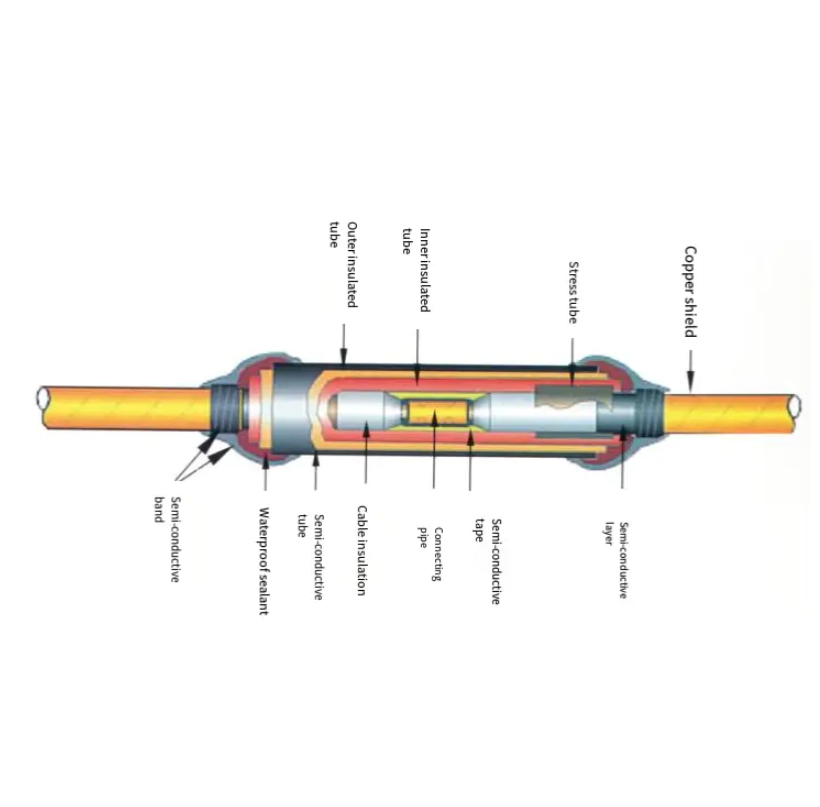
Selecting the right cable accessories factory requires understanding the manufacturing capabilities, quality systems, and product range that different suppliers offer. Cable accessories include essential components like connectors, terminations, joints, cable ties, glands, and heat-shrinkable products that ensure reliable electrical connections in power distribution, industrial, and infrastructure applications.
Manufacturing Capabilities and Technology
A capable factory should demonstrate expertise in multiple production processes. Injection molding is fundamental for producing plastic components like cable ties, glands, and connector housings. Extrusion technology enables the manufacturing of continuous profiles and tubing. For more specialized products, crosslinking techniques and advanced molding processes create heat-shrinkable and cold-shrink accessories that provide reliable insulation and sealing.
Some facilities offer overmoulding services, which encapsulate wire terminations and connectors with durable materials to protect against moisture, abrasion, and environmental conditions. This capability indicates a factory equipped to produce complete, sealed assemblies rather than just individual components.
Product Range and Specialization
Different factories focus on different product categories. Some specialize in wiring accessories, including cable ties, mounting bases, cable clips, spiral wrapping bands, and insulation terminals. Others concentrate on power cable accessories such as lugs, connectors, and heat or cold shrink terminations for medium and low voltage applications.
Factories serving specific industries may offer cable assemblies for aerospace, defense, automotive, or industrial applications, with capabilities for handling coaxial, twinaxial, and specialized connector configurations. Understanding a factory's core specialization helps match its capabilities to project requirements.
Quality Management Systems
Reputable factories maintain formal quality certifications. ISO 9001 certification indicates established quality management processes across production operations. ISO 17025 accreditation for in-house laboratories demonstrates the capability for rigorous product testing.
Third-party product certifications provide additional assurance. UL, CE, and RoHS certifications confirm compliance with international safety and environmental standards. For specific markets, BASEC certification verifies that cable products meet comprehensive testing and production requirements.
In-House Testing Capabilities
Factories with dedicated laboratories can validate product performance throughout production. Key testing capabilities include electrical continuity testing, pull-out tests for mechanical connections, and visual and dimensional inspections. Advanced facilities may perform environmental testing to verify performance under temperature extremes, humidity, and UV exposure.
Testing at multiple production stages helps identify issues before products ship, contributing to consistent quality. Factories with accredited laboratories follow rigorous international testing standards.
Customization and Engineering Support
Many projects require non-standard configurations. Factories offering OEM and ODM services can develop products to specific dimensional, material, or performance requirements. In-house engineering teams with experience in product design and material selection help translate application requirements into manufacturable solutions.
For novel product concepts, some certification bodies offer programs where factories work with third-party assessors to validate new designs against safety and performance requirements.
Supply Chain and Production Capacity
Factory scale affects delivery reliability. Facilities with multiple production locations or integrated manufacturing capabilities across injection molding, assembly, and packaging can manage supply chains more effectively. Understanding a factory's annual production capacity, employee count, and facility size provides perspective on its ability to handle volume requirements.
Factories serving international markets typically maintain relationships with global retailers and distributors, demonstrating the ability to meet varied regional requirements and packaging specifications.
Industry Experience and Market Focus
Long-established factories bring accumulated application knowledge. Facilities founded in earlier decades have extensive experience serving the electrical, construction, energy, and infrastructure sectors. Understanding whether a factory primarily serves industrial, commercial, utility, or OEM customers helps align their experience with project needs.

 English
 Arabic
 French
 Spanish
 Portuguese
 Deutsch
 Turkish
 Dutch
Dutch
 Italiano
 Russian
 Romaian
 Portuguese (Brazil)
 Greek
Greek