
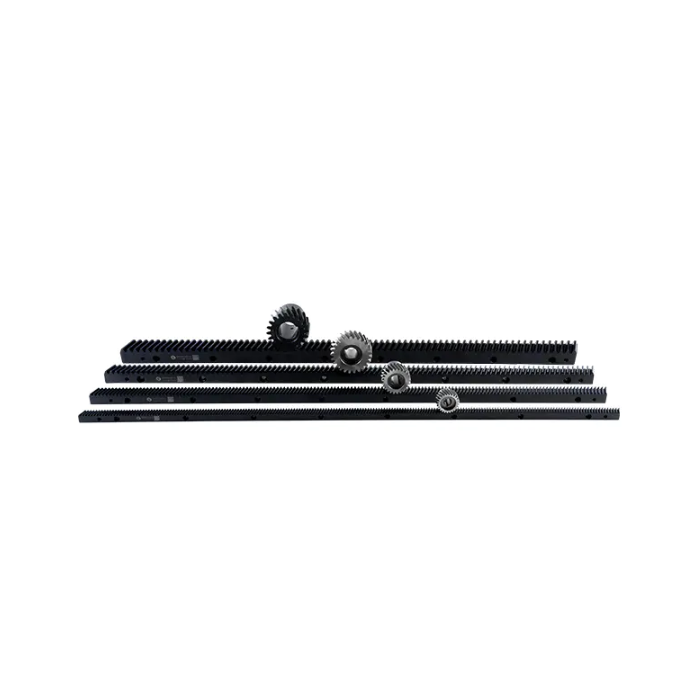
Core Product Definition
A helical ground rack is a precision linear component with teeth cut at an angle to the rack axis, surface-finished through grinding after initial cutting and heat treatment. The helical tooth configuration provides progressive tooth engagement that results in smoother and quieter operation compared to straight-toothed racks . The grinding operation achieves exceptional tooth profile accuracy, surface finish, and dimensional consistency that standard cut racks cannot match. These racks mesh with helical pinions to convert rotary motion into precise linear movement, serving critical functions in applications where positioning accuracy, repeatability, and smooth operation are essential.
Grinding Process and Precision Enhancement
The defining characteristic of a helical ground rack is the post-heat treatment grinding operation that refines the tooth surfaces. After the rack teeth are cut using specialized gear hobbing or shaping machines and the component undergoes heat treatment to achieve desired hardness, precision grinding wheels remove microscopic amounts of material to create final tooth geometry . This process corrects distortions caused by heat treatment, achieves surface finishes measured in microns, and maintains tooth-to-tooth spacing tolerances that meet international precision grades. The result is smooth meshing with pinion gears, minimal backlash, and consistent performance over thousands of operating cycles.
Material Selection and Heat Treatment
Helical ground racks are manufactured from high-quality steel alloys selected for their response to heat treatment and wear characteristics. Common materials include medium carbon steel such as S45C for general applications and chromium molybdenum alloy steel such as SCM440 for enhanced strength and durability . Heat treatment processes including thermal refining and induction hardening of tooth surfaces achieve hardness levels typically ranging from 50 to 55 on the Rockwell scale . This combination of core toughness and surface hardness provides resistance to wear under load while maintaining the material strength needed for demanding applications.
Tooth Geometry and Helix Angle
The helical teeth on these racks are characterized by specific helix angles that influence performance characteristics. Common helix angles include nineteen degrees, thirty-one minutes, forty-two seconds, as well as fifteen degrees and twenty degrees, thirty minutes . The helix angle refers to the angle formed between the tooth and the axis of the gear rack . Different helix angles can be selected based on specific application requirements. The helical arrangement provides greater tooth engagement between the rack and pinion, distributing load over multiple teeth and leading to improved load-carrying capacity and higher torque transmission capabilities .
Accuracy Grades and Standards
Helical ground racks are manufactured to international precision standards that define allowable deviations in tooth spacing, profile form, and overall accuracy. Precision grades according to DIN standards typically range from DIN 5 for high precision applications to DIN 9 for general industrial use . JIS specifications offer corresponding grades from JIS 1 to JIS 5. Higher precision grades correspond to tighter tolerances measured in microns, enabling applications requiring exact positioning and repeatability. The grinding process is essential for achieving these higher precision grades, as cut-only racks cannot meet the tightest tolerance requirements.
Advantages in Operation
The helical design offers significant operational advantages over straight-toothed racks. The gradual and continuous transfer of motion resulting from angled tooth engagement enables smoother and quieter operation . Increased tooth contact area provides improved load distribution and higher power transmission capabilities. Reduced backlash through better tooth conformity results in improved positioning accuracy. These characteristics make helical ground racks suitable for applications requiring precise and robust linear motion, such as machine tools, robotics, and automation systems .
Applications in Machine Tools
Helical ground racks serve critical functions in machine tool applications including CNC machines, milling machines, and machining centers. These components control the movement of cutting tools, workpieces, and tool carriages with the accuracy required for precision machining operations . Long travel axes in gantry-type machines often utilize helical ground racks due to their ability to maintain accuracy across extended lengths where ball screws become impractical. The rigidity and precision of these rack systems directly influence the quality of machined parts and the machine's ability to hold tight tolerances.

 English
 Magyar
 Arabic
 French
 Spanish
 Portuguese
 Deutsch
 Dutch
Dutch
 Italiano
 Russian
 Romaian
 Portuguese (Brazil)
 Greek
Greek